
Overdose Awareness Day remembers those lost, offers help
Trending
STEUBENVILLE -- Family Recovery Center observed International Overdose Awareness Day on Thursday with free resources to prevent overdose deaths, as well as ways to remember those lost due to overdoses.
Recognizing the awareness day for the second year in a row, Family Recovery Center hosted various local treatment providers, many equipped with information and the opioid overdose reversal drug naloxone, distributed through the Ohio Department of Health's Project DAWN, Deaths Avoided with Naloxone.
Family Recovery Center, which offers mental health and substance use treatment through individual or group counseling and medication assisted treatment, said Amanda Kantaras, clinical director. The center's representatives offered naloxone kits, as well as fentanyl test strips, which are used to test for fentanyl in one's drugs. Also offered were drug disposal bags and personal hygiene kits.
Kantaras said, "Our goal has always been to start a conversation among the community about overdoses and what we can do to prevent them. And our goal is always to reduce the stigma so that people feel comfortable reaching out and coming to treatment."
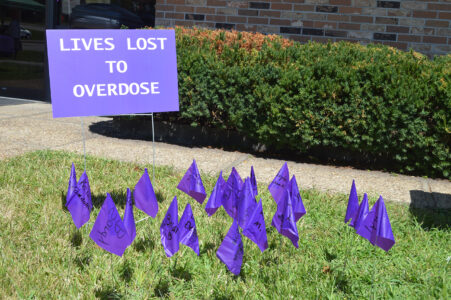
In addition to resources, the event offered a memorial banner on which people could write the names of those who have died because of an overdose. Two separate groups of miniature flags stood in front of the center, placed by visitors: Purple flags represented those who died from an overdose, and white flags represented those who survived an overdose -- the white flags were an addition this year, Kantaras said.
"Being in this work, we go from moments of seeing great successes to moments of loss -- it's a challenging field to be in," said Kantaras, who has been with Family Recovery Center for three-and-a-half years. "It's not just the big goals that we get excited about, it's also the small goals, like when people get jobs, or they go back to school. It's those moments that keep us going."
Kantaras said it is difficult when center staff lose touch with a client, as they worry over the individual's wellbeing. Kantaras said clients who relapse are often embarrassed to return, but she added, "We are genuinely happy to see people come back to us," adding, "And we see recovery. People do recover from this disease."
Regarding substance use disorder being called a disease, Kantaras said research shows how addiction affects the brain, taking away the element of choice for an individual. Oftentimes, she said, people have a predisposition toward addiction, and trauma can feed into substance abuse as well.
Present at the event were some of Family Recovery Center's clients, helping to distribute resources, as well as peer recovery supporter Zach Davidson.
Davidson, who has been in recovery for nearly two years, said of his journey, "One of those white flags is mine, and I have an obligation to give back to my community and try to save as many people as I can."
Kantaras said distributing naloxone and other tools is not enabling for drug users because "if it saves a life then it's worth it."
Naloxone's use can be viewed similarly to how an adhesive bandage functions, Kantaras said, as it "helps people to stay alive long enough so that treatment can be effective and (the person) can recover."
Allison Boston, a prevention educator for Family Recovery Center, said she and other educators were present at the event to give as much naloxone to the community as possible because "you can never be too careful."
"We need to save lives," Boston said, "because you never know what good that life you saved could do for other people."
Among the various treatment providers present was SELF Discovery, based in Mingo Junction. Beverly Rosales, administrative assistant, said SELF Discovery is a substance use treatment facility that offers MAT, individual and group counseling and a three-phase intensive outpatient program.
Another provider was Brilliant Treatment Services, which offers MAT with methadone, naloxone and naltrexone. Director Jessica Tisher said the organization wanted to attend Family Recovery Center's event because of its shared concern with the at-risk population for overdoses, adding, "Anything that we can do to help."
Jefferson County General Health District Commissioner Andrew Henry, and Rachel Shorac, medical assistant, offered information on HIV testing. Henry said the spread of HIV is a concern for intravenous drug users who share needles.
Shorac said the health department offers information on HIV prevention, as well as testing. She added that the health department's goals are to provide people with naloxone, show people suffering with addiction where to turn for help and stop the stigma behind addiction.
"People are scared to get help," Shorac said. "They look at themselves as a failure, or they don't know where to turn, and the public community doesn't like to talk about it."
Henry said bringing naloxone to an event is sometimes like "walking on eggshells" because of public opinion on the drug. Some of that controversy stems from how naloxone is government subsidized, unlike insulin or epinephrin pens, Henry said.
Those uneducated on the topic can mistake naloxone for just another dangerous drug, Shorac said, but it is not possible to get high on or overdose on naloxone.
"The way I look at it, a life is a life," Shorac said of naloxone's usage.
Shorac estimated that around 15 individuals have visited the health department to obtain naloxone this month, apart from the health department's outreach efforts. To pick up naloxone from the health department is anonymous and free, Shorac said, and individuals can trade in their kits if they have met the expiration date. She said it is good for any individual to have naloxone on their person because they never know when an overdose might occur close by.
Henry added, "It's a lot closer to home than people think."
Shorac and Henry promoted a recovery celebration event hosted by the health department, set for 4:30 p.m. to 7:30 p.m. on Sept. 15 at Mazeroski Park in Rayland.
Taelor Maragos and Elizabeth Milbert represented the Federal Communications Commission's Affordable Connectivity Program, which Milbert said offers free tablets or phones with free data plans for low-income or various benefits-enrolled individuals.
Maragos said, "It's constant service without the worry of a bill."
Those who are interested in or might be eligible for the program should contact representatives Josh Grose at (740) 278-2059, Milbert at (740) 298-3880 or Maragos at (620) 333-0276.