
Internationally known landscape architect takes a tour of the area
Trending
STEUBENVILLE -- At 71 and an internationally known landscape architect, photograph and author, Rick Darke didn't have to sign on as consultant to a proposal that hasn't even been funded.
But Darke, who lives in Eastern Pennsylvania, said he was sold on Jefferson Soil and Water Conservation District's Heart of Appalachian Ohio project as soon as he saw the pictures and brochure they sent him of what is there now -- and what they hope it could be.
"I got the inquiry from Aaron (JSWCD Project Manager Aaron Dodds) and he included a PDF with images and it had language -- the images were just drop dead gorgeous and the language was just as pretty and poetic," Darke said.
"I thought, 'this is a person after my own heart', and then I saw the title of the project and it just seemed really authentic and it seemed really smart. And I thought I'd like to work with these people, so instead of emailing them back, I called them because you can do so much more talking with somebody rather than texting or breaking thoughts into little bitty things (for) Twitter. We had a wonderful conversation, and by the end of that conversation I just thought, 'This is the kind of stuff I live for'."
Soil and water's Heart of Appalachian Ohio project spans 17 counties and incorporates more than two dozen activities tied together with they describe as a "common thread" -- pollinator areas or activities that will assist development and sustainability of a pollinator trail. Projects in five additional counties are currently under consideration.
To pay for it, they're hoping to secure funding through the Appalachian Community Grant program, created by Gov. Mike DeWine last year to spark revitalization and collaboration throughout Ohio's 33 Appalachian counties. More than $300 million in grant money is available, with applications due no later than Dec. 9.
The Jefferson County commissioners picked up the tab for Darke's consulting fee and expenses, figuring that the lessons JSWCD learns from working with him would be applicable even if they don't get the grant funding.
The idea, Dodds said, is to "highlight the history and preserve the natural areas (so) younger and future generations will grow up in a world where they coexist and evolve with the concepts of place."
Darke spent 3.5 days in the county last week -- arriving on Monday and departing after a brief Thursday morning visit with Jefferson County commissioners, who had covered his consulting expenses.
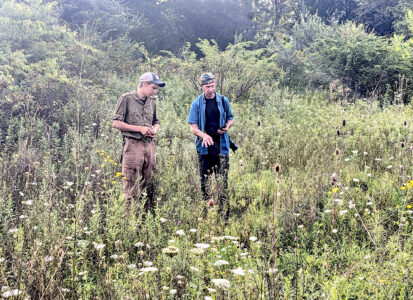
His focus was the Quaker Ridge, Helbender Preserve and Piney Fork properties: Together with JSWCD he walked all three properties, spending 14 hours a day taking stock of the opportunities he saw, creating a photographic catalog of everything he saw and helping the staff develop plans.
"We (walked) tens of thousands of steps a day, not always on trails, looking at plants and animals and trying to figure out what (is there), trying to get vantage points," he said. "You do need imagery that portrays enough, which is why if we can start with this Piney Creek Trail and we can get something that I know would be really visually compelling and satisfying, people will actually come out and see it -- hat's a start. And if they get the Roosevelt Inn open again, that's something else that really, really fits in to this whole vision. People will come."
Darke said he focuses on what he knows will entice people to be outside and look at the beauty around them.
"I call my work 'landscape ethics,' because it's about the ethical constructs by which people interact with their environment and I think it's just a very, very current thought," he said. "And it's an easy thing to love."
Dodds said working with Darke was illuminating.
"We talked about how to 'edit' the bad or the unnecessary out of landscapes, and we began to sketch out ideas and work on design elements of the sites in the field," Dodds said, adding those are concepts that could be applied to other activities in their Heart of Appalachian Ohio project.
He said Darke also shared insights about other projects he's advised, here in the U.S. and overseas, "and what made them successful on a worldwide scale and how we can capitalize on the uniqueness of our space and incorporate elements from other sites to elevate (them) to attract people from all over."
He said Darke told them "the uniqueness and beauty of the region was spectacular and prime to take its place on the world stage" and said Darke "really gravitated toward the Piney Fork property and the Roosevelt Inn," where JSWCD wants to build a trail, redevelop the old railyard, and restore the historic inn. "But he felt there was great potential in all of the projects."
"He said he particularly loved the history of Piney Fork and feels (plans for it) will be monumental and will be able to place the site, along with Quaker Ridge and Hellbender Preserve, on an elevated stage and attract visitors from worldwide," Dodd said.
Darke told them their goal should be to get people "to look a little deeper, look more often" at the beauty nature provides, Dodds said.
"He said we need to build a palimpsest meadow garden that does not erase the history of the site," Dodds recalled. "He said we want to embrace the touchstones of the land that shows the resiliency of the people and place of Piney Fork and Jefferson County. We want to leave reminders of the coal industry and railroad, but also highlight it's now, it's our time."
Darke, he said, "brought a depth of experience and vision that is rare to find, which is why he has been consistently in demand throughout the world."
"He also brings with him a deep richness of collaborators and partners that he can call upon to help refine visions and make them realities," Dodds added. "By bringing Rick Darke to Jefferson County to evaluate our projects, we have begun a monumental task that will elevate the projects to a worldwide audience and give something the residents of Jefferson County and Appalachian Ohio a place to enjoy and grow with for generations to come.
Darke, in return, said he found kindred spirits in Dodds, his wife, Wendee and JSWCD's board of trustees.
"You need beautiful imagery, you need good stories," Darke said, "and I could tell ... these are all people that have a deep feeling for the stories. That's something that is big for me, it's absolutely critical: If people can't articulate why they love this stuff, where does the passion come from? It's hard to get somebody else in on it unless those elements are here. And that was one of the reasons I knew that this is something that is going to be productive."
Dodds said people too often have a tendency to focus on what was once here but is now gone.
"We feel the need to scarify the landscape of the past and tear down vacant buildings and old industry to attract the new," he said. "We fail to see the beauty of the history and the blend of the wild and man-made world -- a vibrant red eft crawling along an abandoned railroad track and the rich texture of a fern sprouting from the crack in the metal of a derelict stone bridge pier is as beautiful as any artwork you would find in a museum. We need to preserve the story of Jefferson County and Appalachian Ohio and repurpose these areas in order to save the story of the people and the region."
He credits Jefferson County Commissioners and the JSWCD board "with giving the county and Appalachian Ohio region a great gift by being able to bring Rick Darke to the county to look over our projects."
"While (he) helped collaborate, develop, and plan for the Appalachian Community Grant application, the development of these sites will not be contingent on the grant funding," Dodds said. "JSWCD had pledged before Darke's arrival to see the projects through and are now more committed than ever to creating these spaces for the benefit of the people of Jefferson County, the Appalachian Ohio region, and beyond.