
How students went back to school in 1880
Differences between today and yesterday
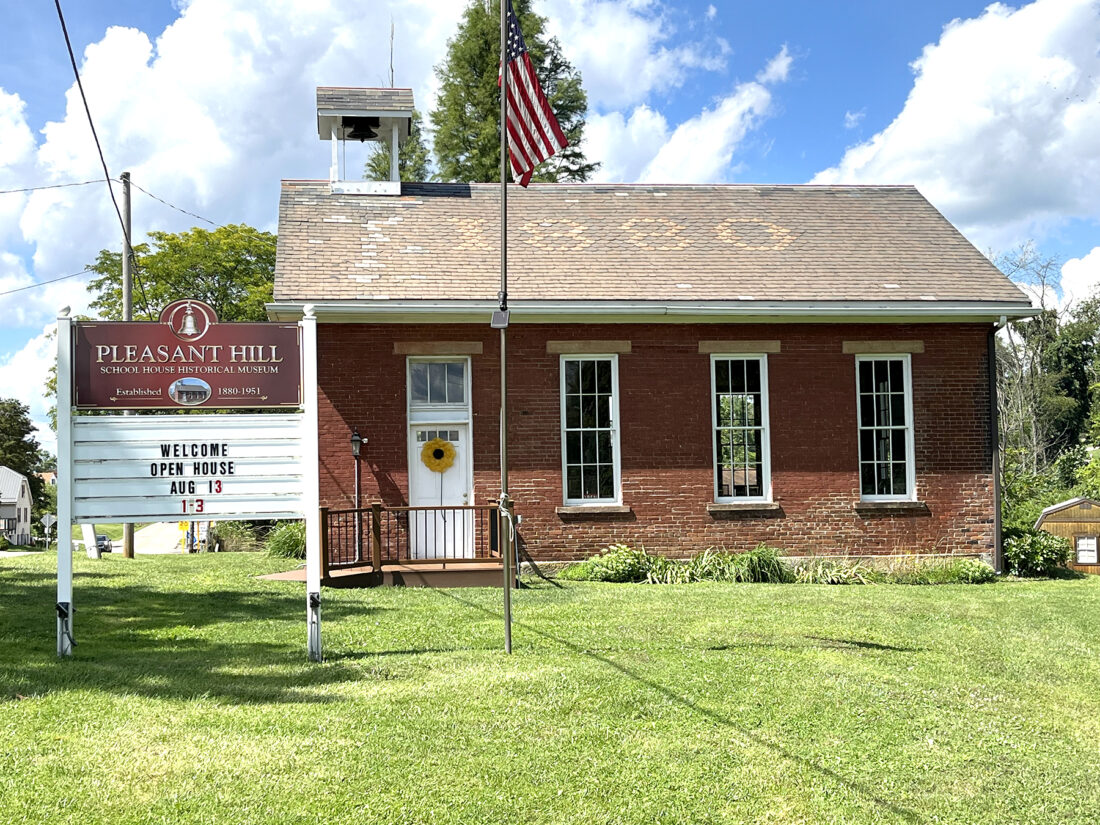
WHAT SCHOOLS LOOKED LIKE — The Pleasant Hill School House Historical Museum on state Route 213 was first constructed in 1836. It was used as a church until 1880 when it became a one-room schoolhouse. Its bell tower has been remodeled and its original bell, refurbished, to ensure the building remains as it appeared when first constructed. -- Contributed
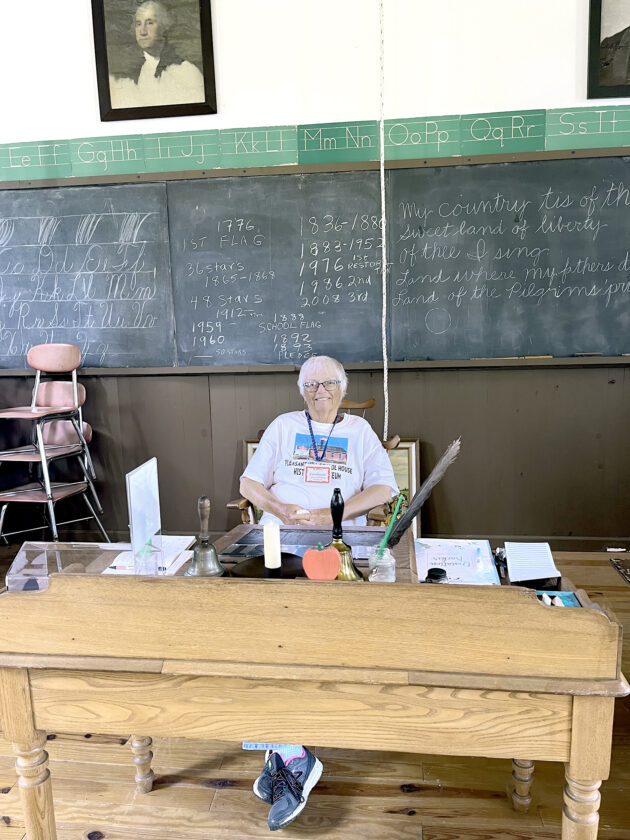
FORMER TEACHER, TEACHING — Former teacher Karen Lundquist, correspondence secretary for the Pleasant Hill School House Historical Museum, volunteered at an open house Sunday. The teacher’s desk at which she sat and background blackboard depict the teaching styles and methods used in the late 1800s. -- Julie Stenger
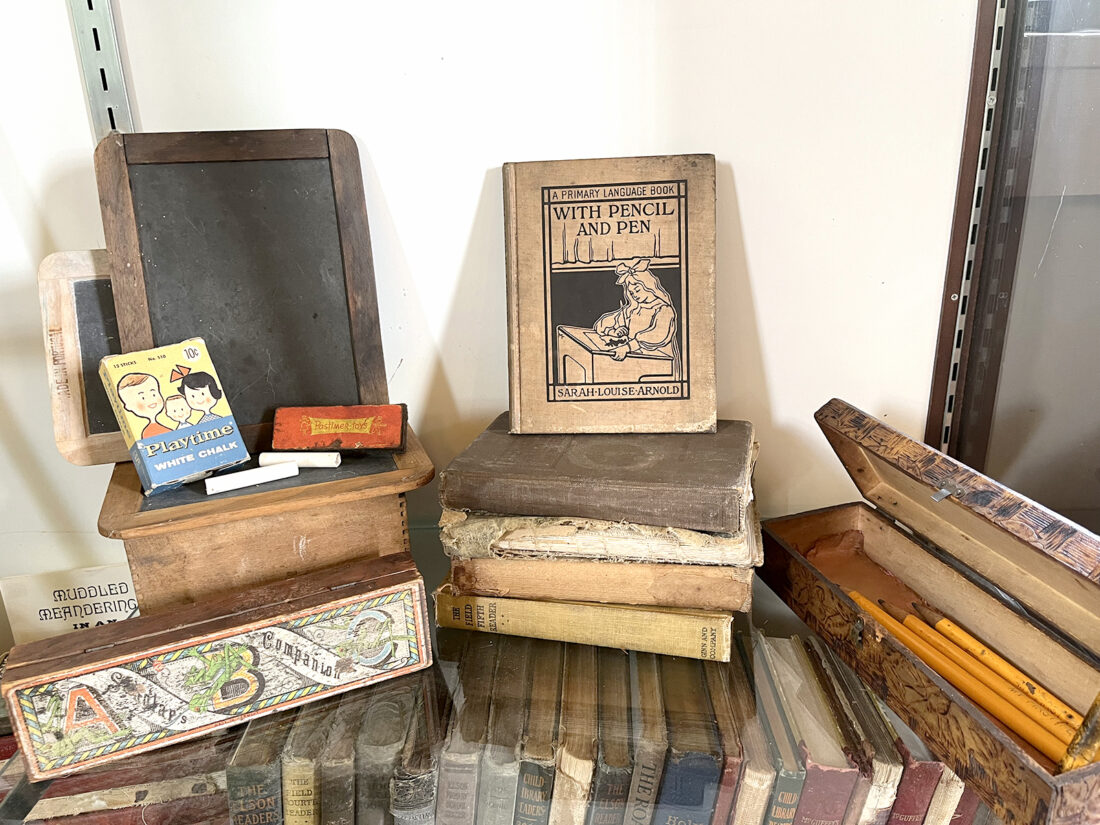
School supplies used by students in the late 1800s differed from those purchased today with items such as chalk, slates and clay pencils;. -- Contributed
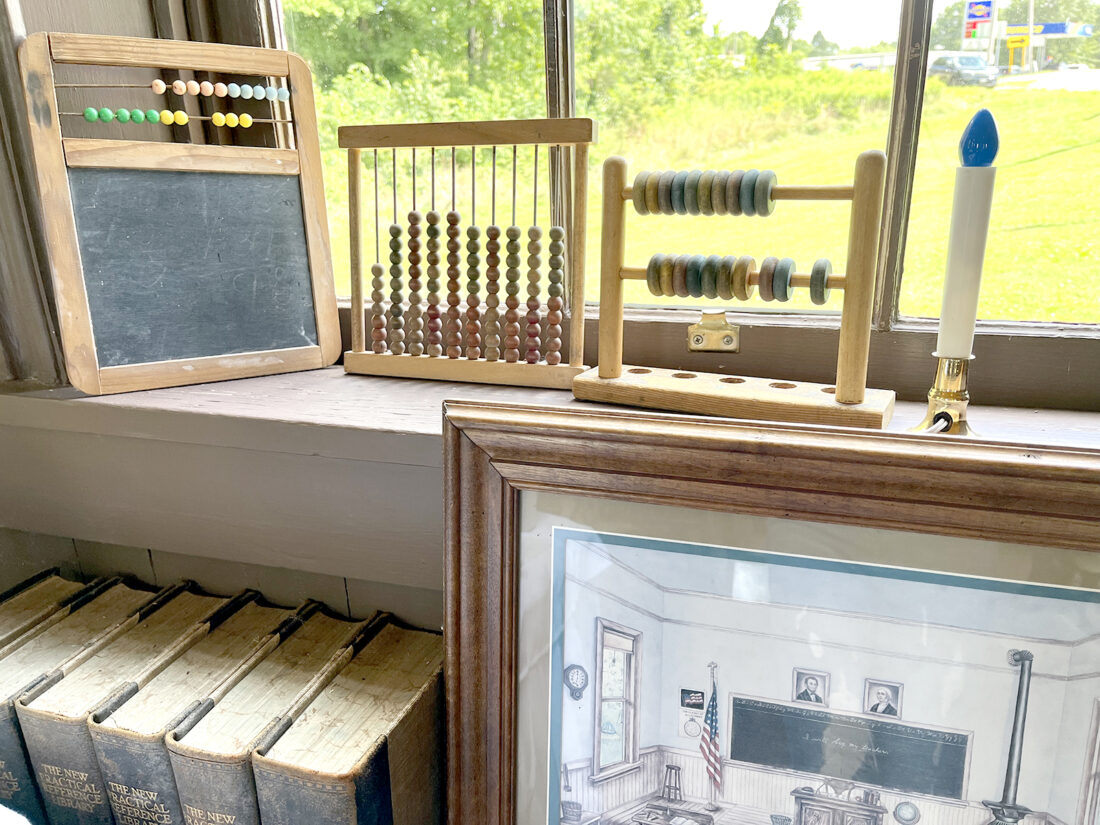
Mathematics were taught with the use of an abacus. -- Contributed
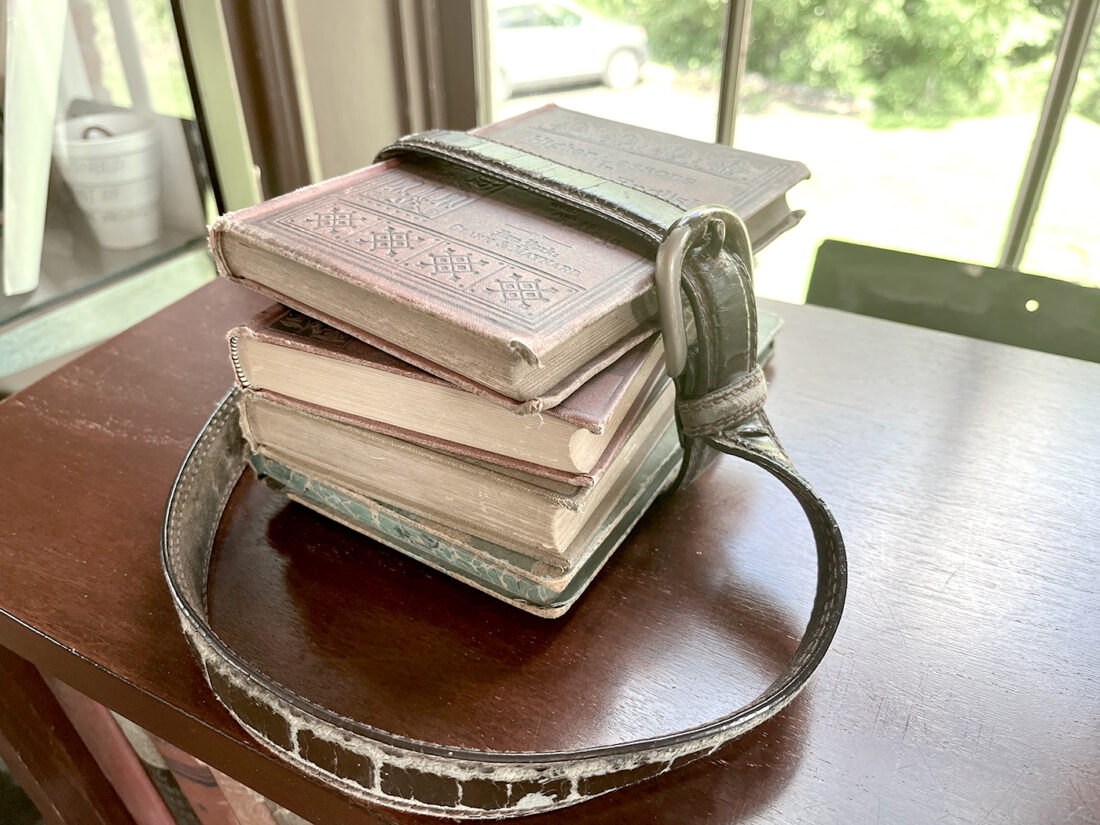
Backpacks were not yet created, leaving students to carry their books in a belt, at right, so they would not get lost or dropped on the miles-long walk to and from school. -- Contributed
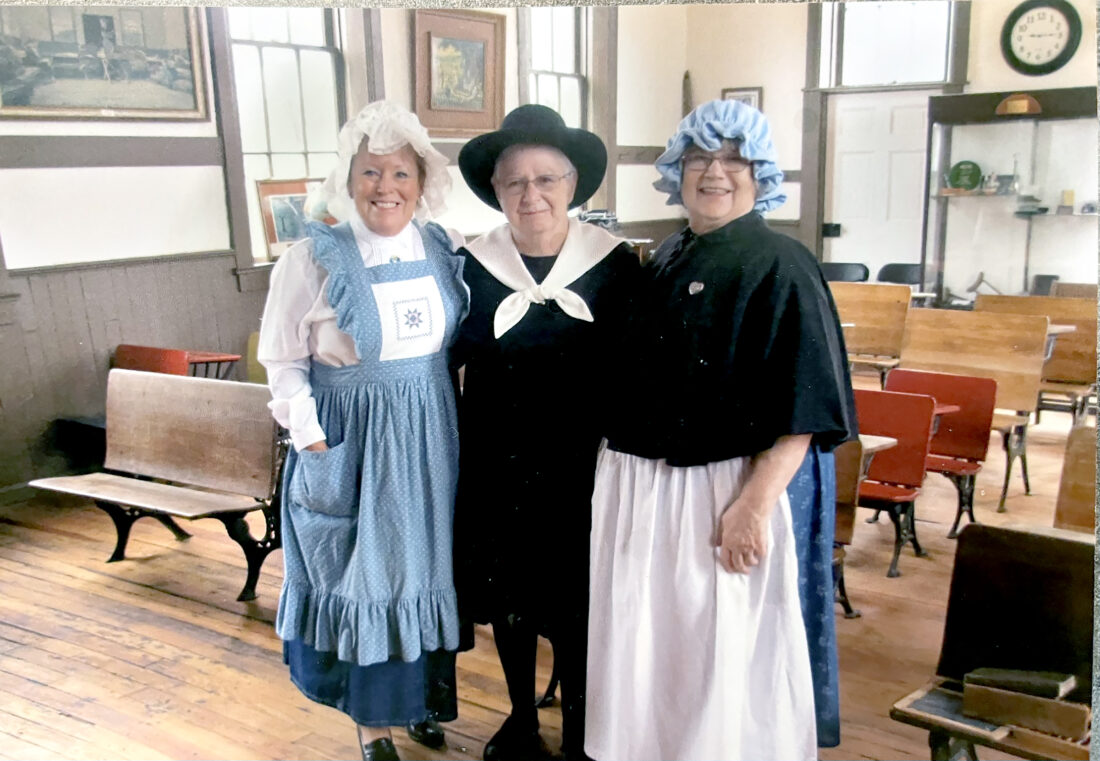
FASHION FROM THE OLD DAYS — Former school teachers, from left, Joyce Zimmerman, Connie Crawford and Avis Henry wear the attire of the 1880s while volunteering at the Pleasant Hill School House Historical Museum on state Route 213. -- Contributed
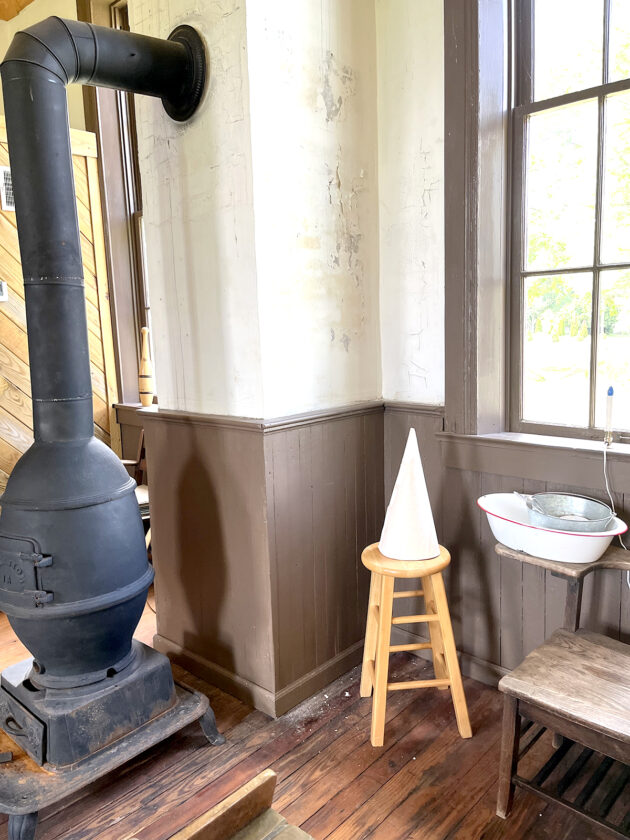
DUNCE CAP — A dunce cap was worn by those misbehaving, with the letter “D” written on the cap for dunce, meaning “idiot.” The stool sat beside a pot-bellied stove, which provided the only heat source for students. -- Contributed
WHAT SCHOOLS LOOKED LIKE — The Pleasant Hill School House Historical Museum on state Route 213 was first constructed in 1836. It was used as a church until 1880 when it became a one-room schoolhouse. Its bell tower has been remodeled and its original bell, refurbished, to ensure the building remains as it appeared when first constructed. -- Contributed
FORMER TEACHER, TEACHING — Former teacher Karen Lundquist, correspondence secretary for the Pleasant Hill School House Historical Museum, volunteered at an open house Sunday. The teacher’s desk at which she sat and background blackboard depict the teaching styles and methods used in the late 1800s. -- Julie Stenger
School supplies used by students in the late 1800s differed from those purchased today with items such as chalk, slates and clay pencils;. -- Contributed
Mathematics were taught with the use of an abacus. -- Contributed
Backpacks were not yet created, leaving students to carry their books in a belt, at right, so they would not get lost or dropped on the miles-long walk to and from school. -- Contributed
FASHION FROM THE OLD DAYS — Former school teachers, from left, Joyce Zimmerman, Connie Crawford and Avis Henry wear the attire of the 1880s while volunteering at the Pleasant Hill School House Historical Museum on state Route 213. -- Contributed
DUNCE CAP — A dunce cap was worn by those misbehaving, with the letter “D” written on the cap for dunce, meaning “idiot.” The stool sat beside a pot-bellied stove, which provided the only heat source for students. -- Contributed
Trending
In the coming week, children throughout America will return to the classroom.
Their cell phone alarm will ring, they will begrudgingly shower, decide what to wear from an extensive wardrobe, grab a granola bar or iced coffee and head out the door with their earbuds, iPads, laptops and backpack of school supplies. They will then catch a bus or drive their own vehicle to an air-conditioned, well-heated building where they will receive breakfast, lunch and vending machine snacks while receiving a thorough education within an oversized building containing extra, unused rooms and be taught by a dozen different educators who will not physically discipline or harm them in any way.
Most students, when asked, will tell you they think they have it hard. But little do they realize how much easier life has become.
Just ask a student from the 1800s.
Their parent would wake them, no shower to speak of, with work taking precedence over learning since farming was the way of life for most families. A morning of labor started off the day, followed by breakfast if the family had anything in their homes to eat. They then walked miles to a one-room building which had no air conditioning or central heating and where it was their responsibility to light the pot-bellied stove with the armful of logs they had carried from home. No lunch or breakfast was served in the one-room building they would be confined in for the entire day. There was one teacher not much older than the students themselves who would instruct each student in every grade at once. And misbehaving -- that resulted in a very unpleasant punishment.
A better depiction of what life was like for students in the late 1800s can be seen firsthand by visiting the Pleasant Hill School House Historical Museum on state Route 213.
According to the women who began the restoration project of the one-room schoolhouse, Gloria Renda, Connie Crawford and Karen Lundquist, it literally took a community to make the project what it has become today. Donations, luck and many blessings have made it possible to maintain much of the original features.
Crawford and Lundquist explained the building was constructed around 1836, serving as a church until 1880. It then became a schoolhouse until 1952.
It was a home for a few local families through until the late 1970s and then a first attempt to restore the building was made in 1976, Lundquist said.
A second attempt at purchasing and restoring the building came in 1986.
It wasn't until 2008 that a third attempt was made at getting the one-room schoolhouse by Renda, Crawford and Lundquist. Finally, officials approved their request and it was then that the real work began.
Today, tours are given to any of the area's schools for classes wanting to take a field trip and visit the museum. There are open houses held for anyone in the community interested in visiting and seeing what life was like for students more than a century ago. The open houses are held on the second Sunday of the month between 1 p.m. and 3 p.m.
Visitors will notice the blackboard at the front entrance contains only cursive writing. The alphabet is spelled out in cursive letters, as children did not print back then.
The center of the blackboard contains the words to "God Bless America" which was sung at the beginning of each day. There is a flag for reciting the Pledge of Allegiance, which was said each morning, as well. The museum has flags for each year a new flag was added, including the 13-states flag.
Lundquist explained a walk-through of the structure allows guests to pull the rope of the original bell which once called students to the start of the school day. The bell can be heard for more than a mile, she noted, as it had to be loud enough for everyone to hear it so they knew it was time for them to come to school.
The original bell was given to the museum by Clarence Virtue who took possession of the item when he served as a principal. Not knowing what to do with it, he placed it in his barn where it sat until he heard the old schoolhouse was being restored. He took it to Crawford and asked if she would like to have it.
Of course she did.
The bell was refurbished and placed in the reconstructed bell tower, thanks to the work of Fred Mehling, Crawford commented.
One will learn upon entering the museum how paper was expensive in the 1800s and students used slabs of slate, taking notes with slate pencils made of clay. Paper was saved for penmanship lessons, which entailed using quills dipped in ink to practice cursive writing.
Textbooks were equally scarce and not provided by schools. Students used either their parent's old books or borrowed from older students. No one had a matching copy. Many books from the early 1900s line the shelves of the museum, along with 1908 McGuffy Readers and charts.
The original lesson charts used to educate pupils in reading and English are on display, and extra care has to be taken to ensure their keep. Crawford made a trip to Cleveland to have them restored, noting the lab wanted $5,000 to soak them in brine. She opted to use a local business at less cost.
"The charts have to be kept at a certain temperature," she commented, adding an air conditioning unit and furnace were installed for that reason. The furnace was donated by Trey Hendricks, son of retired teacher and museum volunteer Debbie Hendricks, she said.
The schoolhouse had approximately 48 students and a single teacher who was usually around the age of 14, Lundquist stated. The first few rows of desks housed the younger pupils who were known as abecedarians because they learned their ABCs.
With this many students crammed inside a small space, it was imperative to maintain discipline. Punishments could be harsh. Those who misbehaved would either receive detention, suspension or expulsion. But oftentimes, the outcome resulted in a lashing with a whip, as was permissible by the Board of Education in Franklin, Ohio.
Corporal punishment was allowed as long as the teacher did not inflict pain upon the head or hands. Not all places had this rule though and rulers or pointers were used to lash student's knuckles or palms. Other discipline procedures included making the child hold a heavy book for more than an hour.
Sometimes emotional pain outweighed the physical hurt, as children who misbehaved were made to wear a dunce cap. The triangle, cone-shaped hat publicly shamed the child, as the "D" on the cap stood for dunce, which means, "idiot."
There are currently 19 states which still allow corporal punishment to take place within the school system.
The museum has a paddle placed next to its front door as a reminder of the punishments local children had to endure.
In order to graduate during the 1800s, students had to pass a final exam at the eighth-grade level. Questions included: Naming the parts of speech and defining those that have no modifications; a math scenario wondering how many bushels of wheat will a wagon box hold that is 2 feet deep, 10 feet long and 3 feet wide; and what are the elementary sounds and how are they classified?
In order to graduate today at a 12th-grade level, a minimum of 20 credits in specified subjects is needed to take the required tests in English, health, mathematics, physical education, science, social studies and electives. One must receive instruction in economics and financial literacy and complete at least two semesters of fine arts. Then, students must decide on rounding out diploma requirements and earn a passing score on Ohio's high school Algebra I and English II tests. A student then has to earn two diploma seals, choosing among what lines up with their goals and interest.
Notable moments in education include: Passing the constitutional amendment in 1875 mandating free public schools so even the poor could attend school; creating child labor laws in the early 20th century and making it illegal to employ children, allowing more students to attend school rather than work in the fields or mines; the National Defense Education Act of 1958 which provided additional funding to schools in order to improve the standards of American education due to the Soviet Union launching Sputnik and the concern the Russians were more advanced in science, technology, engineering, and math; the Nation at Risk report in 1983, indicating schools were failing to adequately prepare students and therefore implementing the Next Generation Science Standards in order to create STEM education in kindergarten through 12th grades so as to better prepare students for careers in these fields. The No Child Left Behind Act of 2001 attempted to finish what the Nation at Risk standards began, creating a set of federal grade-appropriate standards for each subject area and having teachers conform lessons to these standards and then proving students mastered these concepts through standardized testing.
Looking back over the last century, one can see the advancements made and how far society has come.
But in certain aspects, perhaps the question should be asked, "Is the world really a better place because of it?"