
Former governor visits Steubenville, encourages “no” vote on Issue One
Trending
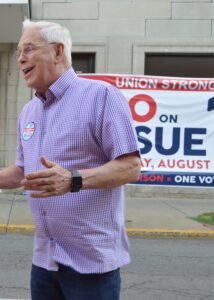
STEUBENVILLE -- While Steubenville celebrated with its First Fridays event, former Gov. Ted Strickland visited downtown to meet with people and discuss the importance of voting "no" on state Issue One.
Strickland, who served as the 68th governor of Ohio from 2007 to 2011, said he came to visit the Jefferson County Democratic Party headquarters at the corner of Fourth and Washington streets to "see some of my old friends" and speak on Issue One, which will be on ballots for Tuesday's special election.
"Primarily, I came to ... encourage them and their friends and their neighbors and as many people as they can contact to get out next Tuesday and vote "no" on Issue One," said Strickland, who has also served as a U.S. congressman, representing Ohio's 6th Congressional District, which includes Jefferson County.
Issue One is a controversial ballot measure that seeks to increase the number of approving votes needed to pass an amendment to the Ohio Constitution from a simple majority, 50 percent plus one vote, to a super majority of at least 60 percent.
The current simple majority system has been in place in Ohio since 1912.
Proponents for Issue One have said these changes are necessary protections to defend the Ohio Constitution from special interest groups. However, opponents say these measures will restrict citizens' say in regard to future amendments.
"Issue One is an attempt to change our state's constitution to get rid of provisions that have been in that constitution for over 100 years," said Strickland, "and (it) is an attempt to make it difficult -- in my judgment, impossible, if it were to pass -- for the citizens of our state to ever have an opportunity to gather signatures and put an initiative on the ballot that would bypass the politicians in Columbus and remedy the wrongs that the people of Ohio think the legislature is not responding to."
Strickland said the passing of Issue One would put issues Ohioans care about at risk, including labor laws, right-to-work legislation, environmental policies and tax issues.
Issue One is not a partisan issue, Strickland said. Rather, he said, both sides of the political aisle are uniting in opposition to Issue One. He said both sides should be concerned about Ohioans retaining their direct voice regarding placing constitutional amendments on the ballot.
Strickland, a Democrat, is one of four former Ohio governors who have voiced their opposition to Issue One. Among them are Republicans John Kasich and Bob Taft and Democrat Dick Celeste. In favor of Issue One is current Gov. Mike DeWine, a Republican.
Strickland said Issue One, which he called "the most important decision that the people will make in the last 50 years," is the effort of special interest legislators who "are afraid of losing the power they have."
Strickland's visit came nearly a week after a visit from Ohio Secretary of State Frank LaRose, who spoke at Steubenville's First Christian Church about Issue One and his own 2024 Senate bid.
At that event, LaRose had said Issue One is necessary to prevent legislation from being enshrined in the Ohio Constitution that does not belong there. He compared the sizes of the U.S. and Ohio constitutions, saying that the Ohio Constitution is much larger because it is too easy to amend and therefore contains material inappropriate for the document, which should be focused on fundamental principles rather than specifics.
Addressing the issue of whether the Ohio Constitution should be amended as much as it is, Strickland said state constitutions are different from the U.S. Constitution in that they address specific issues that the more general U.S. Constitution does not deal with.
"They're very different documents," Strickland said, "and to pretend that state constitutions ought to be treated like our federal constitution is just a misunderstanding."
Strickland spoke on comments from LaRose, specifically those made last year in regard to special elections. Strickland said LaRose himself opposed August special elections until recently, "flip-flopping" on the topic to support Issue One's appearance in an August special election.
This was in regard to House Bill 458, legislation passed by the Ohio Legislature in December 2022 that largely eliminated August special elections.
Strickland called LaRose's actions "sneaky" and said LaRose acted in a way that we in his best political interest. Also, Strickland said, the special election will cost taxpayers $20 million to hold.
"Frank LaRose underestimate the people of Ohio," Strickland said, "because people understand what's going on now, and the early vote is much higher than expected, and more people are coming out to vote 'no' than to vote 'yes.' Frank LaRose is going to be embarrassed Tuesday night."
The passing of Issue One would also increase signature gathering requirements for ballot initiatives. Gatherers would be required to obtain signatures from 5 percent of voters -- based on the results of the last gubernatorial election -- in all 88 of Ohio's counties, an increase from the current requirement of 44 counties.
Strickland said the count requirement would make the already difficult signature collecting process even more difficult. He also said the change would enable one county to block an entire ballot initiative, a claim that LaRose previously said is only possible if the entire voter base in a county thinks and votes the exact same way.
LaRose has been the target of controversy following his campaigning for Issue One. The Libertarian Party filed a complaint on Monday with the U.S. Office of Special Counsel, claiming that LaRose's public support of Issue One is in violation of the Hatch Act. The complaint says, "Secretary LaRose, who administers federal funds for elections supplied to his Office under federal law, has used and is using his office and official authority to influence, interfere with and affect an Ohio election."
LaRose has said he did not violate the Hatch Act. In Steubenville, he said there is a precedent for secretaries of state to campaign on current issues.
"When I do my job of being secretary of state, I follow the law, whether I like it or not," LaRose said.