
Ohio secretary of state supports Issue One, draws protesters
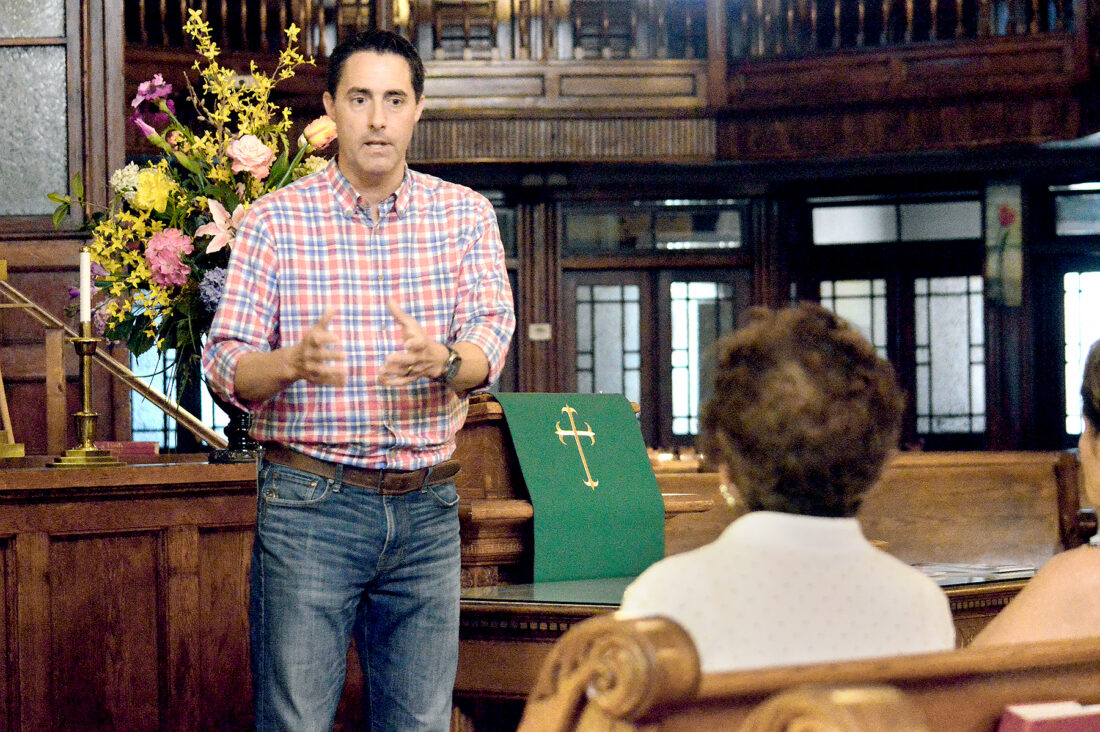
IN SUPPORT — Ohio Secretary of State Frank LaRose, 2024 candidate for U.S. Senate, answered an audience member’s question about state Issue One during his discussion about the issue Saturday. -- Christopher Dacanay
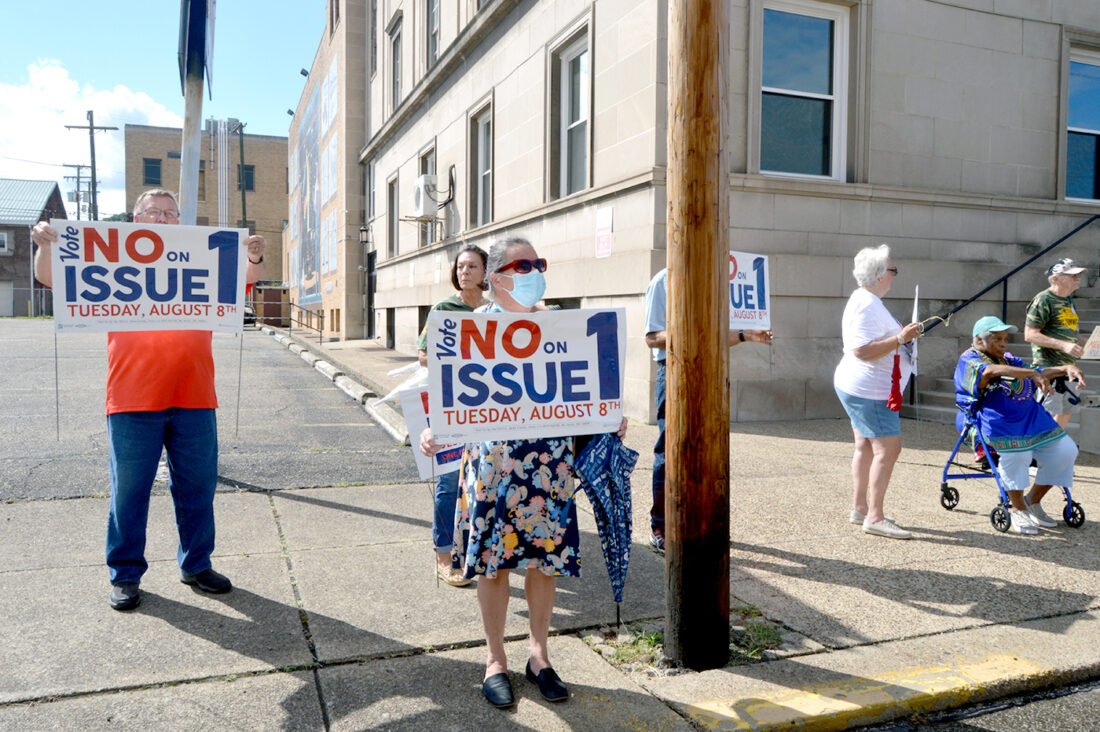
IN OPPOSITION — A group of protesters from the Jefferson County Democratic Party voiced their opposition to state Issue One by demonstrating outside First Christian Church while Ohio Secretary of State Frank LaRose spoke in support of the issue inside. -- Christopher Dacanay
IN SUPPORT — Ohio Secretary of State Frank LaRose, 2024 candidate for U.S. Senate, answered an audience member’s question about state Issue One during his discussion about the issue Saturday. -- Christopher Dacanay
IN OPPOSITION — A group of protesters from the Jefferson County Democratic Party voiced their opposition to state Issue One by demonstrating outside First Christian Church while Ohio Secretary of State Frank LaRose spoke in support of the issue inside. -- Christopher Dacanay
Trending
STEUBENVILLE -- Ohio Secretary of State Frank LaRose spoke in support of state Issue One on Saturday, saying the issue must be passed to defend the Ohio Constitution from special interest groups.
Having served as the secretary of state since 2019, LaRose announced his candidacy for the Republican nomination for the U.S. Senate on July 23. Since then, he has been traveling throughout the state speaking about his candidacy and Issue One, which appears on Ohioans' ballots on Aug. 8 in a special election.
LaRose's recent stop brought him to downtown Steubenville's First Christian Church, where he spoke to a few dozen listeners while a smaller group of protesters demonstrated their opposition to Issue One outside and across the street.
"There will be plenty of time to talk about (my candidacy)," LaRose said at his speech's beginning, "and for me, that'll be after Aug. 8 because we've got more immediate work in front of us right now, and that's passing Issue One."
LaRose talked about the purpose behind a constitution, saying they are the "very foundational rules" that establish the framework of a state, nation or organization. He said the content of a constitution should include fundamental rights that are broadly agreed upon and not controversial.
"You know what constitutions are not for?" LaRose asked. "They're not for policy making ... (or) passing the day-to-day laws. ... But that's what others want to try to do with our state constitution."
LaRose compared the sizes of two physical copies of the U.S. Constitution and the Ohio Constitution that he had with him. He said the former is about 7,000 words, compared to the latter, which is about 70,000. He said this discrepancy stems from the Ohio Constitution being too easy to amend.
"(The Ohio Constitution) is too easy to amend, and, as a result, folks have put things in here that really don't belong in a constitution," said LaRose, adding that special interest groups have lobbied to add restrictions on casino plots into the Ohio Constitution.
Among the protesters outside was Eddie Abdalla, chairman of the Jefferson County Democratic Party Central Committee, who said the secretary of state taking a stance on a current issue is concerning.
"The secretary of state is in charge of the elections in the state of Ohio, and it's a nonpartisan position," Abdalla said. "And if the person in charge of elections can try and persuade people one way or the other on an issue that's on the ballot, we don't believe that that's fair or possibly even legal."
LaRose said there is no conflict of interest, saying there is a precedent of Democrat and Republican secretaries of state campaigning for issues throughout history. Ohio's system, he said, allows for the election of partisan officials who swear to uphold the law regardless of how they feel about them.
"When I do my job of being secretary of state, I follow the law, whether I like it or not," LaRose said.
Since 1912, the Ohio Constitution has required a simple majority -- 50 percent plus one vote -- for new amendments to pass. State Issue One, if passed, would increase the vote requirement to 60 percent, known as a super majority because it exceeds the simple majority threshold.
The Vote No in August campaign opposes Issue One on the grounds that, if Issue One is passed, majority rule in Ohio would be replaced with as little as 41 percent of voters being able to block a proposed amendment.
The U.S. Constitution, LaRose said, already requires a super majority vote in the House of Representatives and the Senate for an amendment to be proposed. Furthermore, an amendment must be ratified by at least 75 percent of the states before approval.
LaRose said, "The left has figured out that, if you're willing to spend enough money, relatively easily, compared to the U.S. Constitution, you can amend (the Ohio Constitution), and now it's time that we stepped up and did something about that, and Issue One is that something."
Majority rule would still be "alive and well" following the passing of Issue One, LaRose said, because Issue One only affects proposed constitutional amendments. Issue One would not touch existing legislation that requires a 50 percent vote to repeal laws, change them or pass new ones in the Ohio General Assembly.
LaRose addressed another contentious provision in Issue One regarding required signatures. If Issue One is passed, any proposed amendment's initiative petition must acquire signatures from at least 5 percent of voters -- based on the county's total vote for governor in the preceding election -- in all 88 of Ohio's counties, increasing from the current requirement of 44 counties.
Although abortion legislation is not the only influencing factor for Issue One, LaRose had said earlier, he said the Ohio Right to Make Reproductive Decisions Including Abortion Initiative "would make Ohio really the most extreme state in the country when it comes to abortion."
The initiative has made its way onto the November ballot, proposing an amendment for the Ohio Constitution entitled "The Right to Reproductive Freedom with Protections for Health and Safety."
LaRose said of the initiative, "It would create the ability for people to have late-term abortions all the way up through the third trimester, and it would take away any parental rights."
The initiative itself does not explicitly speak about parental rights, but it states, "Every individual has a right to make and carry out one's own reproductive decisions, including but not limited to decisions on contraception, fertility treatment, continuing one's own pregnancy, miscarriage care and abortion."
Furthermore, the initiative states that an abortion can be prohibited if the patient's treating physician deems the pregnancy viable, though "in no case" may an abortion be prohibited if the treating physician judges it to be necessary for preserving the patient's life or health.
LaRose said the initiative's parental rights precedent could be applied in the future for gender transition surgeries. Other initiatives on the horizon LaRose said people should be concerned about include increases to the minimum wage, implementing "radical livestock care standards" and eliminating qualified immunity for law enforcement.
"The list goes on and on," LaRose said, "and it's every radical, West Coast policy you can think of that they want to try to bring to Ohio. ... These groups know that they can probably never get 60 percent of Ohio to agree to something as extreme as those things that I just listed.
"If you've got 51 or 52 percent that like your idea, you can change the law, and that's the right way to do it, but unless you build a broad coalition of at least 60 percent, then you should leave our constitution alone."
LaRose said that the Aug. 8 special election will be determined by whichever side is able to get the most people to come out and vote, as polls show both sides being neck-and-neck. He asked listeners to vote "yes" and to tell their friends to vote as well.
LaRose answered audience questions, saying that labor unions should support Issue One to protect currently enshrined labor rights from being changed. Also, he said the assertion that one county can block a ballot initiative's signature collection is untrue because it would require every single voter in the county to think the same way about the initiative.
Addressing why Issue One is appearing on an historically low-turnout special election, LaRose said he had wished it to be on the ballot in May during the primary, which did not happen, but the oncoming abortion initiative had rushed the issue this year.
LaRose's 2024 Senate candidacy will pit him up against a growing field of Republicans who are looking to take on incumbent Sen. Sherrod Brown, a Democrat who has held the seat since 2007, in the 2024 general election.