
Health program in Mingo Junction offers help for drug, alcohol abuse
Trending
MINGO JUNCTION -- SELF Discovery, a health program located in Mingo Junction that treats drug and alcohol abuse, is set to expand after almost three years of helping those with substance use disorder.
Kerry Sneddon, program director, said SELF Discovery offers a three-phase intensive outpatient program. An IOP, Sneddon said, is high-level care for those struggling with addiction, and it focuses on goals like coping skills and relapse prevention.
IOPs are different from in-patient programs, Sneddon said, because patients at the former can come and go from home to the treatment. In-patient programs, on the other hand, require patients to reside in the facility.
Talking through the struggles with individuals in similar situations is important for clients in the program, Sneddon said, and it is lived out through weekly meetings in groups of 12 clients, facilitated by a therapist.
"The smaller the group the better," Sneddon said, "because they have more of that one-on-one attention so (the clients) don't get lost in the group.
"You want to meet the client where they are in their recovery," Sneddon said, noting that a person's recovery journey should be individualized. "No two recovery programs will be the same for two individuals."
During the IOP's first phase, group meetings are required for clients three times a week for about 12 weeks, although lengths for each phase are target goals.
Continuing to meet in the group, clients in phase two are required to meet three times a week for about eight weeks. Finally, clients in phase three meet twice a week for about eight weeks.
Additionally, clients also receive one-on-one sessions with therapists each week, Sneddon said, adding up to 10 hours each week at first that clients participate in the IOP.
Group meetings further the treatment for the clients' substance abuse. All clients have individual program goals they must attain during their time in the IOP. Goals include recognizing triggers, developing coping skills, furthering self-awareness and learning to ask for and receive support, among others.
Once a client has achieved these goals and is verified by a treatment support team, Sneddon said, the client "graduates." However, care does not end there. Clients have the option to participate in an after-care program, where they meet again as a group to provide peer support, facilitated by a therapist.
The medication-assisted treatment program, Sneddon said, is for those struggling with addiction who qualify for medication. Through MAT, they can receive medications to treat opioid or alcohol use disorder.
"(The after-care group) is a group of clients who have completed their IOP and who need the extra support," Sneddon said, "and (MAT) clients are in that group as well for the same reason: to get that additional support."
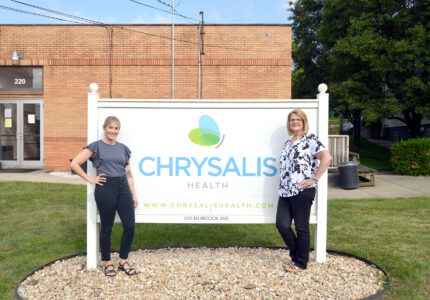
SELF Discovery is designated as a "health empowerment program" by its owner and Florida-based health care provider, Chrysalis Health. SELF Discovery was established in Steubenville and will have been in existence for three years in October, Sneddon said.
The program relocated to Mingo Junction about two years ago, and is looking at further expansion.
Sneddon said SELF Discovery recently hired new personnel, including a court system liaison and a therapist to conduct new evening IOP group meetings, which have not been launched yet.
The evening program, she said, will mirror the day program but provide an alternative time for clients who are unable to come during the day because of work. The program is awaiting referrals.
SELF Discovery has seen an increase in referrals, Sneddon said, considering how the day IOP group used to have around two clients. Also, another group that addresses alcohol, was reopened in April and is at capacity.
Sneddon said SELF Discovery will be branching out into Belmont, Harrison and Monroe counties, where the programs will mirror what is offered in Mingo Junction. Harrison and Belmont will see a new program focusing on methamphetamine.
Sneddon said she credits her team at SELF Discovery for the expansions. It is because the staff has kept courts up to date on the state of clients that they have received their referrals, Sneddon said.
Jenna Porter, substance use therapist, estimated that about 90 percent of the program's clients come from referrals. Referrals can come from clients' lawyers, mental health court, drug court, county court, municipal court, job and family services and probation or parole officers. However, clients can refer themselves if they want to seek help.
SELF Discovery's building is located at 220 Murdock Ave., next to St. Agnes Catholic Church. The program moved into the building almost two years ago, taking over what used to be St. Agnes Central School, which closed in 2006. SELF Discovery's business hours are 8 a.m. to 4:30 p.m. from Monday through Thursday and 8 a.m. to 3 p.m. on Friday.
On the program's Facebook page, many posts speak about a colors of the day. This is a system the program uses to choose clients for random drug screenings. Sneddon said each client is assigned a color. Random colors are chosen each business day, and the clients whose colors are chosen must come in for a screening.
Part of Sneddon's role, she said, is performing community outreach and filling gaps in health care needs. She said, SELF Discovery is partnered with the Ohio Department of Health's Project DAWN, through which SELF Discovery distributes naloxone, a medicine that reverses opioid overdoses.
SELF Discovery also uses grant funds from the Ohio HEALing Communities Study to provide a transportation voucher to individuals who are unable to transport themselves to the Mingo location.
Sneddon said that, in addition to her, the Mingo location currently employs two full-time therapists; two part-time therapists; two providers, including a doctor and a certified nurse practitioner; one court liaison; and a full-time case manager.
Sneddon said the work SELF Discovery's team does is important because of the prominence the drug problem has in society. She said the goal is to help the clients to "live their lives to the fullest."
She added helping parents struggling with addiction to heal through an improvement plan is important so that families can be reunified.
"It's better that we keep all familiar together as much as possible," Sneddon said, "getting the help for the parents so the kids have a fighting chance."
Porter works as one of SELF Discovery's substance use therapists. She facilitates the three-day-a-week group meetings and meets with clients for individual sessions.
Everyone on SELF Discovery's team pulls his or her own weight, Porter said. That teamwork is critical to make sure no clients "fall through the cracks."
"I am recovering myself," Porter said, "so working with other addicts and alcoholics and seeing them grow, seeing where they started and where they're headed is a reward in itself.
"Even if we only touch one person that day and if they walk out of here and they feel like their life is better ... and they have some hope for the future, then that's enough reward."