
Council seeks information from soil and water district
Trending
STEUBENVILLE -- City Council had plenty of questions Tuesday about Jefferson Soil and Water Conservation District's Appalachian Community grant proposal, which currently reaches into 10 counties.
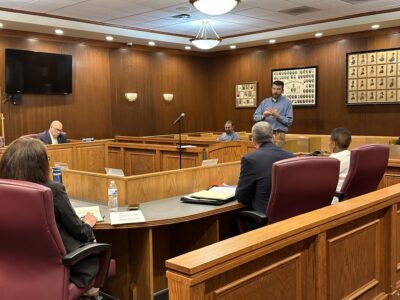
After getting an overview of the JSWCD proposal during a planning committee meeting, council spent the rest of the hour-long session questioning Projects Director Aaron Dodds about why it makes sense to partner with communities in other counties, some as far as a 100 or 200 miles away.
Next week, they hope to do it all again, this time with Jefferson County Port Authority Director Robert Naylor, who is overseeing development of a county proposal.
"As we look at our needs in the city, to me I think we need to recognize our needs are constantly evolving," Sixth Ward Councilman Mike Hernon said prior to the start, telling council and those in the gallery that they needed to "see how we, as a council, want to move forward."
While no vote can be taken in committee, Hernon said council needed information in order to "make sure we're making the wisest decision possible."
Dodds, who stressed he was at the meeting at council's request and was not soliciting their involvement, said the Appalachian Grant guidelines encourage applicants to "think beyond county lines, they want you to think not as a Jefferson County resident or a (Meigs) County resident but as an Appalachian Community resident."
JSWCD's projects were originally under the port authority's umbrella, but Dodds said they pulled them when they realized there's was "a pretty big project, we realized we needed to take responsibility."
"Ultimately, we made the determination that we had to do what was in the best intests of ourselves and the people w'ere putting our faith in," he said. "We needed to make sure the buck stopped with us."
He said JSWCD's proposal involves projects in 10 counties, but he's been asked to meet with officials in six others. "Hopefully, if everything goes well, we'll have 16 counties in our project," he said, telling council they currently have "31 unique activities" within our project.
He said JSWCD's pollinator trail is a common thread, "We could almost tie in any project by planting areas with native pollinators and carrying that through."
"Through tourism, recreation, arts, environmental components and history, we started to really focus and form a project out," he said. "I can stand here and tell you all our projects have interconnections and are woven together, so no one project stands alone."
He said their focus has been on regionalization, which is one of the core grant requirements. He also said JSWCD has not solicited involvement by other groups reiterating that, "We have not solicited any projects that were originally in the Jefferson County project, but we have taken some that asked us to."
He said Burgess & Niple, the Columbus firm helping them put the application together, told them it's six points shy of a perfect 100 on the grant's scoring rubric, scoring especially high on its regional impact. He said the state wants to see a broad impact.
"It's disappointing but selfishly good that a lot of them are only focused on their own county," he said. "It's disappointing because they know the scoring rubric, (the state) wants to see four or more counties (in an application). Ultimately, they're hurting themselves. From my talks with Ohio Department of Development and our procured planners (Burgess & Niple), the fact that we're coming in regional is going to help our application out."
He said JSWCD's proposal includes the Hellbender Preserve, which includes, among other things, turning an old school in Wayne Township into a community center, a Piney Fork bike trail, the Quaker Ridge arboretum, two battlefields, a food bank in Muskingham County and reimagining a Columbiana County building with a rich history that's currently in a state of ruin into an event space connected to some parks that are nearby.
"You're talking about a bigger vision, right?" Hernon asked. "So, what city projects would fit with the vision you've put together?"
Dodds reminded him he wasn't there to solicit projects, adding they are willing, if the city wants to look at it. " There are probably ways we can fit in ... some projects like the marina, the (downtown) streetscape."
"But the most important thing is at the end of the day, when you lay your head down, you make sure you're doing what is best for your projects, your city," he said.
Dodds pointed out the deadline is just about five months away, and he's told everyone who's asked to be part of JSWCD's project that he wanted to know in the next few days "so the planners could get going."
"That way we can systematically go through the projects and see what everybody needs," he said. "Some are quit advanced, they're shovel ready. Others need more (work). Ultimately, when I meet with the planners and some other individuals in the first of July, I want to be able to say, 'Here's my project, here's the common thread and the narrative we're working off now."
In response to questions from council, Urban Projects Director Chris Petrossi said that, other than the initial meeting and e-mailing some information to the county planners, he hasn't heard anything on the city's projects, currently under the port authority umbrella.
Asked what JSWCD would gain by the city's participation, Dodds told council they could build off "each others' stories."
"We're basically stitching together a quilt, cinching everything together so we have a tighter story, and at the end of the day it will be stronger."
Fifth Ward Councilman Willie Paul wanted to know if projects as far away as Jackson County are part of the JSWCD proposal, "how (the JSWCD proposal) is going to benefit the citizens of Steubenville? I want our constituents to have something," while Fourth Ward Councilman Royal Mayo pointed out they're already in with the port authority and asked Petrossi, "If we weren't in with the port authority and went with somebody else, what's best?"
"I have no idea where my vote should go," Mayo said.
"That's hard to answer right now," Petrossi replied. "As Aaron said, there are going to be three or four large applicants."
Hernon said what council has to figure out is "what's going to put us in the best position" to capture some of the Appalachian Grant money.
"Right how, you have 10 counties and it could go up to 16," he said. "Where do we fit? Will we still be given love as (your proposal) continues to grow or will we be a small fish in a big pond? Is the state going to be funding just big projects?"
Dodds told council there's "only going to be four or five projects funded. ODOD made no bones about it. They want $50 million plus projects."
"We are very regional," he said. "Some counties are not thinking outside county lines ...and ODOD is starting to think they might have to combine some projects to get them beyond county lines."
His advice to council was to look at who else is in their project and will it be regional. "For your projects to be strong, you need to make sure you have a regional component--you have to have at least four counties. If you don't, you need to be concerned."
"At the end of the day, everyone's got to be able to lay their head on the table and say I
Mayo questioned the emphasis on connectivity, asking, "What does it actually do for us in terms of getting money?"
Dodds told him if two applications are equal, "the tiebreaker becomes the narrative. Selling the narrative, selling the story of this region. Whether it's the marina or the Morgan's Raid battlefield, (the state wants) you have to make (the narrative) significant enough ... that people want to come here not only to visit, but to stay."