
Class recreates Ford engine
Trending
BLOOMINGDALE -- Power mechanics students at Jefferson County Joint Vocational School have taken a step back in time to recreate inventor Henry Ford’s first engine.
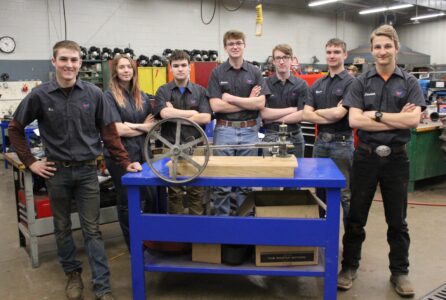
Juniors and several seniors in instructor Fred Jones’s program spent the past few months building the contraption known as the kitchen sink. It got its name when Ford tested the engine on the kitchen sink after supper on Christmas Eve of 1893. According to historical information, he ran a wire from the ceiling’s light bulb and his wife, Clara, hand fed the gasoline to the intake valve while he spun the flywheel. The engine roared into action and shook the sink.
It was the first time Jones’s class underwent such a task after he researched ideas online.
“They needed a metal lathe and milling project and built a replica after I bought a blueprint online,” Jones said. “We are building three based on the drawing.”
Work began shortly after they returned from Christmas break and students built the ignition system and all of the machinery. Students participating in the project include Andrew Wetherell, a junior at Catholic Central High School; Ian Hojonski, a junior at Buckeye Local High School; Victoria White, a junior at Harrison Central High School; Kaleb Griffith, a senior at Edison High School; Ben Carpenter, a senior at Edison; William White, a senior at BLHS; Jeremiah McGalla, a senior at Edison; and Brennan Simms, a junior at Edison.
The engine features metal pieces and a flywheel set upon a wooden board and measures more than 15 inches long, 35 inches wide and 13 inches high. Jones said his pupils learned milling machine and lathe working as well as ignition timing and other factors, and plans are to power the engines using hydrogen fuel.
“By the end of the year, we hope to have them run off hydrogen fuel using water,” he explained. “That occurs when you add electricity to water and boil off the hydrogen.”
Jones said the goal was for students to understand the inner workings of the old-fashioned systems.
“It’s not the easiest thing to get running but they’ve got it.”