
Trinity Health System’s Structural Heart Team passed a significant milestone
Trending
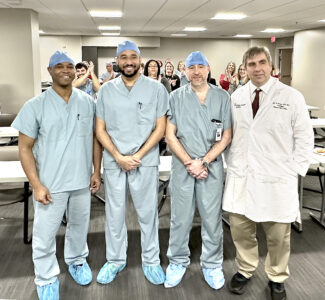
STEUBENVILLE -- Trinity Health System's Structural Heart Team passed a significant milestone Tuesday, performing its 100th transcatheter aortic valve replacement.
TAVR, a minimally-invasive alternative to open heart surgery, is designed to treat aortic stenosis, a narrowing of the aortic valve that blocks the flow of blood in the body and forces the heart to work harder.
Surgeons use a hollow catheter to place a new valve mounted on a balloon into the patient's heart. When it's in position, the balloon inflates and the new valve starts working.
TAVR patients "are typically up and walking in six hours and most go home the next day," said Dr. Triston Smith, director of the structural heart program and interventional cardiologist.
Smith and Drs. Gregory Suero and Victor Maevsky started TAVRs at Trinity about 18 months ago, though they'd done them before in Wheeling.
"The advantage of doing it is you don't need general anesthesia, we don't need to open the patient's chest," Smith said. "It's very minimally invasive."
The procedure was first developed about 20 years ago in France, "then it slowly gained traction," he said. Doctors in the U.S. got the go-ahead to perform TAVRs around 2014.
"We've seen a very fast uptick in use because the technology is so good and patients do so well with it," Smith said. "Initially, it was just approved for patients at prohibitive risk for surgery. Now it's approved for anyone, as long as we have a heart team discussion of the pros and cons of traditional heart surgery vs TAVR, and then communicate that information to the patient."
But it's not for everyone: For some patients, the risk is higher with TAVR rather than traditional surgery, and there's limited data on the durability of the replacement valve, so for younger patients in good health otherwise traditional surgery might still be the better option.
"There are criteria that we use to determine which ones should be done," Suero said, medical director and invasive cardiology, interventional cardiologist. "(But) it's not a hard sell. In fact, the harder sell is trying to tell them their risk of TAVR is higher than their risk of surgery, so we recommend surgery. Right now, selling surgical aortic valve replacement is harder than TAVR."
He said it's up to the team to make sure patients know the benefits and the risks.
"Every patient is evaluated by the heart team -- the cardiologist, referring physician, cardiac surgeon, the anesthesiologist, the echo team," Suero said. "We do a series of tests and, based on the results of those tests, we get best available risk estimate of that patient. Based on that risk, we make a recommendation on which procedure would be better for the patient and we take that information to the patient and the family, so they can make the best choice.
"We don't turn anyone away unless we see something in their tests, evaluation" that make it risky for the patient, he added.
And those who do get the TAVR procedure done "come in for regular follow-up office visits. "They get an echo cardiogram every year and we take a look at the valve," he said. "The data we have so far is (gathered) during 10 or 12 years (of use), so we know they can last that long and get to that mark."
When a patient gets to that 10-12 year anniversary, "that's when the chances of them needing another procedure is present," he said, though that could change as more data comes in.
Suero said reaching the 100 TAVR milestone "is a great achievement for us and for our community."
"I think it speaks highly of the commitment Trinity Health System and Common Spirit have to patients and the community," he said. "It's a great service for the patient and they don't have to leave town to get the care they need
Maevsky, a cardiothoracic surgeon, said it's particularly gratifying to see patients get immediate relief with quick recovery, "twenty-four hours vs three or four days in the hospital, and there's less pain involved."
And, he said a TAVR typically takes anywhere from 45 minutes to an hour-and-a-half to do. Even patients who've previously had surgical valves can undergo TAVR.
"I'm very happy the community trusted us to perform this process," Maevsky said. "We've been doing it a year-and-a-half without complications, without any mortality. We've had perfect results -- not a lot of programs can say that."
Open heart surgeries have been performed for the last 40 or 50 years "and are still considered the standard of care," Maevsky said. "But the data from TAVR is very compelling, too, and is also very good, as good as for surgical valves. We just have (longer data) for surgical valves."
He said the meticulous workups they do prior to the procedures mean they've "put the dots on the I's and crossed all the T's to make sure the procedure can be done without any problems."
"It's improvement of quality of life but more importantly, it's improval of survival," Maevsky said. "We know that statistically, for someone diagnosed with severe aortic valve stenosis, the mortality of that patient reaches almost same level in two years as Stage 4 lung cancer. We know that. And when you put that in perspective, you understand the validity of this procedure."