
Orthodox Christians marking Christmas
Trending
STEUBENVILLE -- While some area residents already have taken down their Christmas trees and put away their holiday decorations, others are just getting started.
Holy Resurrection Serbian Eastern Orthodox Church, located at 528 N. Fourth St., Steubenville, for instance, was a place busy with preparations Wednesday in anticipation of Christmas Eve today and the celebration of Christmas on Saturday.
Orthodox Christians from throughout the Ohio Valley and the world celebrate Christmas Eve and Christmas later than the American Christmas observance because they follow the Julian calendar, which was used during Christ's life and is 13 days behind the more commonly used Gregorian calendar.
Members decorated the sanctuary with poinsettias, and a small group worked to make symbolic versions of the badnjak, or yule log, which is blessed and burned outside the church near the bell tower at the Christmas Eve vigil service presided over by the Rev. Stavrophor Rajko Kosic. Serbians are the only Orthodox with the yule log/badnjak tradition.
The smaller variety they made for parishioners earlier this week combined straw symbolizing the manger where the Christ child was born and oak branches representing the cross. The two are secured by red, blue and white tri-color ribbon.
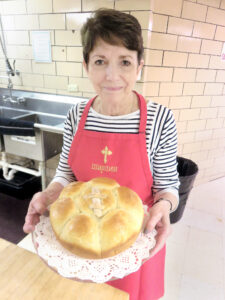
Such traditions don't go unappreciated by Charlene Stanich, president of the Sveta Petka Kolo women's group from Steubenville, who made Cesnica, Serbian Christmas bread, this year for the first time.
Stanich, who converted to the faith about 14 years ago after the closing of her small Presbyterian church in the Pittsburgh area, was satisfied with her first attempt at what is a key component of a Serbian Christmas meal. Her husband, Gary Stanich, president of the church's executive board, took pictures of the process.
"I am -- it looks OK," she said, inspecting the bread that will be part of the fare parishioners will eat at the church after services on Saturday. True to tradition, the bread contains a coin baked inside it. Everyone breaks off a piece in hopes of getting it.
"I put a quarter in the middle," she said, explaining it supposedly brings "good luck and lots of money" for the remainder of the year to the one who finds it.
Wearing her red apron on which her name is written in Cyrillic, Stanich noted she has read of other items that can be used in place of a coin -- everything from a cornelian cherry to symbolize good health to wheat, indicative of a good harvest or a fruitful year.
Eggs and milk are among the ingredients for the highly anticipated Christmas bread, according to Stanich, who explained that "all through Advent we fast -- we don't eat any dairy or meat, so that's from the end of November until Saturday, Christmas Day."
The top of the round bread can be adorned with baked-on dough decorations that look like wheat or grapes, for example, and what Stanich found to be the most difficult part. She shared photos of some ornately done versions she found online but kept to putting a simple cross on hers.
While Stanich is a newcomer to the Christmas bread, she has been a helper in making the special bread for communion with fellow member Sandy Connell of Weirton.
"That's called Prosfora," she said, noting its ingredients are only flour, water, yeast and salt. A seal is used on the top of the loaf.
"I married my husband 39 years ago, and I always said I didn't rush into it because we were already married 25 years when I converted, and I have just been gradually learning," she said of the traditions.
Another holiday bread is Kolach, a circular sweet bread.
"We celebrate our patron saint, and ours happens to be St. George, and we celebrate in May," she explained. "On that day you come to church and bring Kolach, and depending on whether it's a fasting period or not, it's prepared without milk and eggs or with, and some people put flavorings in like zest or something to make it have different flavors, but you bring that, and the priest prays over it, he cuts it and breaks it, and we spin it first and then he cuts it, and he breaks it and prays over it and pours wine in it and you pass it around and kiss it. He says, 'Christ is in our midst,' and everybody else says, 'He is and always shall be,'" Stanich explained.