A special library spot for an orphan collection
-
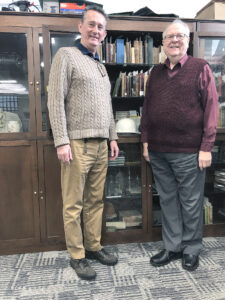
- RIGHT AT HOME — Mike Gray, left, director of the Public Library of Steubenville and Jefferson County, and Alan Hall, director emeritus, stand in front of the library’s archive collection that Hall has been working on since 2019. — Contributed
-
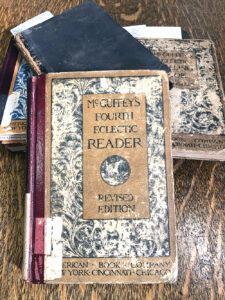
- The archive collection includes the McGuffey’s Reader. — Contributed
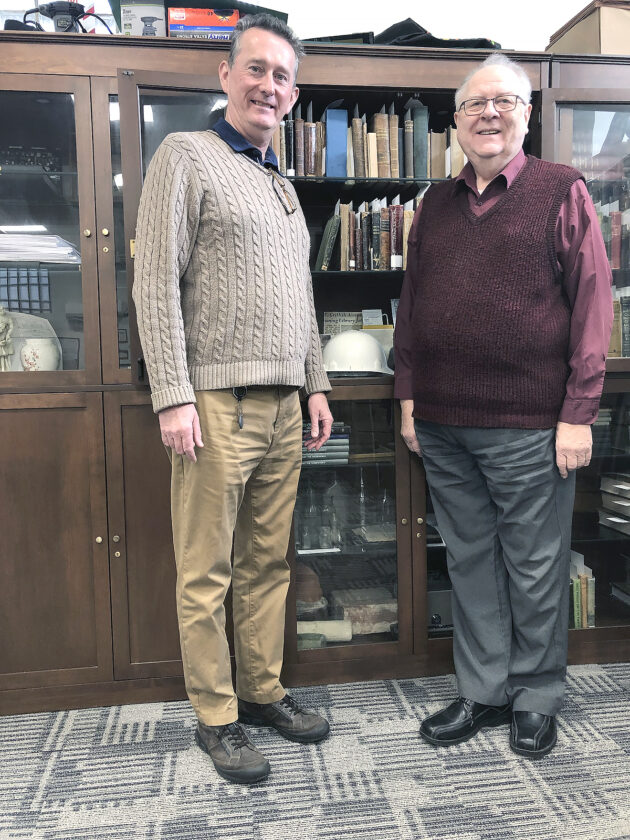
RIGHT AT HOME — Mike Gray, left, director of the Public Library of Steubenville and Jefferson County, and Alan Hall, director emeritus, stand in front of the library’s archive collection that Hall has been working on since 2019. -- Contributed
Any librarian has a shelf someplace that contains books that can’t find a place on some shelf in the library.
The books may be older, perhaps in poor condition, maybe with a subject of little interest to current readers. My office was no different — a couple of shelves of books that I called the “orphan shelf,” containing books that I found interesting but wouldn’t fit a collection.
In 1991, a woman brought me her copy of a “McGuffey Eclectic Reader.”
It was a sad little book, badly worn from several family members using it in school –lots of writing on the pages and a worn spine. McGuffey’s were used from 1836 until 1960 as primer textbooks in schools across America, authored by William Holmes McGuffey (1800-1873) as a professor at Miami University of Ohio, and Ohio University. Six grade levels were covered starting with phonics, completed by readers written by his brother, Alexander Hamilton McGuffey — both with connections from Claysville, Pa., to New Philadelphia.
Her book was a reader published in the 1870s, but used into the 1930s.
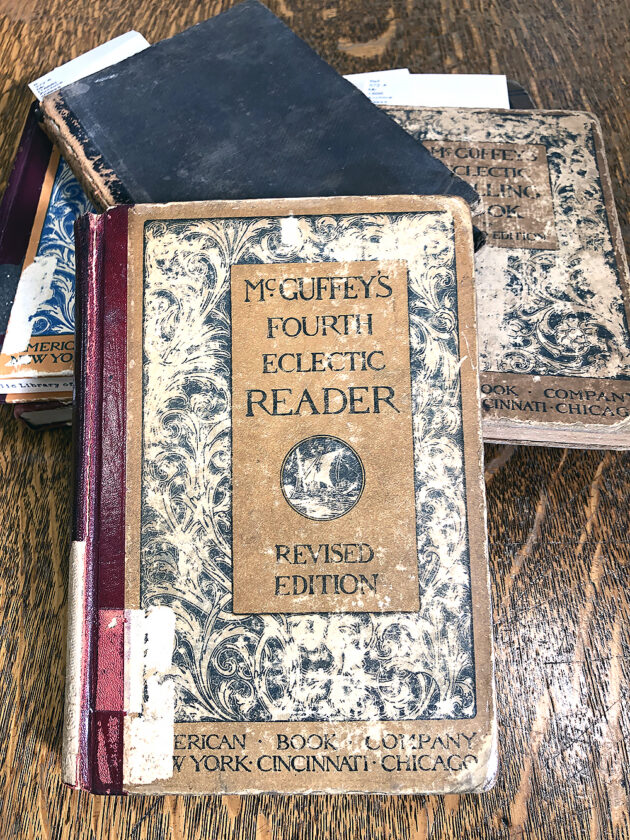
The archive collection includes the McGuffey’s Reader. -- Contributed
I didn’t want to tell her that the library system really couldn’t use this little book — but I told her I would keep it as an example for others. She was delighted, and I placed the book on a shelf in my office and would often look at it over the years remembering her words.
I got to thinking how nearly all academic and research libraries, and some public libraries have an “archive” or “rare-book collection.”
As my career was approaching its end, I had the honor to plan and design the renovation and addition to our Carnegie Main Library and had “made a spot” for the orphan collection in the new administrative offices. One day, I was meeting with the architect for a final meeting before the project went out-to-bid, and he swung his arm toward my orphan collection and asked, “What are we going to do with this bunch of junk?”
The librarian came out of me — “bunch of junk?” — how dare he make such a comment!
Actually he was right, it was not an impressive group of books …. but I said defiantly to him, “These books are the root of our new archive collection, and there are new cabinets in the administrative area for them.”
The collection was boxed up and stored away awaiting the completion of the building project and arrival of the new cabinets.
When the library was completed and reopened to the public in 2019, the boxes were stacked in front of the cabinets, and I had retired. During that time, the computer network that served the library system had changed the cataloging protocol and eliminated the systemwide cataloger, and each library had to perform its own unique cataloging for items that didn’t have online records available so I offered to become that cataloger for the Public Library of Steubenville and Jefferson County in my retirement.
After all, I processed books and barcoded them over the years, and had taken cataloging classes in Library School way back in 1976, so I took online classes for cataloging as well as classes at the computer center and became an OHIONET Cataloger.
I began searching online to see how unique the books in the orphan collection were, and if other libraries owned them. For books we wanted to keep, I used my restoration and mending skills (no longer taught in Library School) to make some repairs and put the cataloging information on acid-free slips and put the collection in Dewey Decimal order in the new cabinets.
Library collections today are accessible through online databases, ours containing 98 library systems with 250 outlet locations. A worldwide database operated by OCLC Inc. in Columbus shows holdings around the world so I began searching and downloading records for “our” archive.
The oldest book in our archive is the 1794 “Sacred History” by Thomas Ellwood, published in London by Phillips Publishers. Other libraries owned the title, but ours had the names of James Baker, written in the front page, as owning the book in 1812, and John Baker owning it in 1890.
I treated the leather binding with a compound to make the book look a bit better.
There is an 1818 and 1846 Holy Bible, the older one described as a “Pittsburg edition” of the King James version.
The “Ainsworth Dictionary of English and Latin” is an 1825 edition commonly used in 19th century schools to learn Latin and had been carefully preserved by a previous owner. Two school dictionaries accompanied the book.
Interesting to note that written in the front of that dictionary is “Grove Academy” which may or may not be related to the Steubenville Female Seminary that operated from 1829-1899.
The “McGuffey Reader” had been joined by several other such Readers spanning 1874-1930, a couple found in a file cabinet saved by an earlier librarian for me to add to the archive.
Early children’s books made it into the archive, as before 1900 children had to read adult titles before books were written specifically for children. “Miss Theodosie’s Heartstrings” by Annie Hamilton Donnell was a 1916 publication specifically for children’s eyes, as well as “Uncle Wiggily on the Farm,” an illustrated 1939 book full of ink drawings.
A friend of mine gave me a 1912 copy of “Sinking of the Titanic — World’s Greatest Disaster — Memorial Edition” published late in the year of the sinking of the great ship. I found it at a garage sale and thought it might be valuable, until I showed him advertisements from a variety of bookstores selling copies for a few dollars. He gave it to me for the archive, and since then we have had a couple requests for copies of the survivors of the Titanic, contained in that book.
In 2019 as the collection was assembled, a descendant of the McFeely Family of which three generations had resided in Steubenville from 1814-1898 offered the library a dozen books that had been in their family before they moved to Pittsburgh and then Latrobe, Pa., to form a brick factory. The grandson of the brick factory was none other than Mr. Rogers of PBS TV fame, and he used his ancestor’s name for one of his show’s characters, Mr. McFeely.
The collection of books contains a Bible, a Latin textbook and an 1840-era family encyclopedia showing how to do around-the-house chores and repairs of that era. We also have a binder of documents and paperwork from the McFeely businesses in Steubenville during the 19th century.
It is interesting that library staff will often forward me possible books for the archive collection hat appear in boxes of books for the Friends of the Library annual book sale. The collection has grown to about 150 books which we display from time to time in the cases at the Main Library and Schiappa Branch Library.
This is different from the Local History Collection that is maintained at our Schiappa Branch in that department which concentrates on Jefferson County and neighboring county’s history.
There are times I wish that the books in the archive collection could talk and tell me where they lived in their shelf life, who owned them and who read them.
Local News
Summer adult education courses available at Jefferson County JVS
BLOOMINGDALE – People looking to expand their horizons can now take part in summer adult career training at ...
Ferguson, Hoagland clash in race for Ohio 96th District seat
Editor's Note: A production error kept this story from running in its entirety with its initial publication. Below ...
Wednesdays in Wintersville kicks off new season
WINTERSVILLE — Joel John likes to talk about the growth he has seen in the event —and the village — since ...
Officials urge support for Steubenville police, fire tax levies
STEUBENVILLE — When Steubenville voters head to the polls Tuesday, city officials are hoping they think about all ...
Hancock County 4-H camp is going Medieval
NEW CUMBERLAND — Youth across the region are invited to step into a world of adventure, leadership and fun at the ...