
Complaints aired about natural gas compressor near Wellsburg
Trending
FOLLANSBEE -- On Thursday, residents near a natural gas compressor station asked officials to address pollution and noise from the facility before recommending it for a permit from the U.S. Environmental Protection Agency.
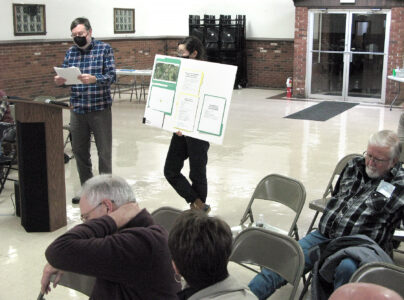
Residents living near the facility at 4928 McAdoo Ridge and others from Western Pennsylvania attended a public hearing on the matter held by the West Virginia Department of Environmental Regulation's Division of Air Quality at the Follansbee Community House.
Such stations are placed along natural gas transmission lines to maintain the flow of gas from area well sites to its end users.
Officials with the state agency said following the issue of a permit to build the facility, operators of such stations must seek a Title V permit from the EPA if it could potentially release 100 tons or more of hazardous air pollutants in a year.
Under the permit, the station could produce, per year, up to 73.98 tons of carbon monoxide, 108.32 tons of nitrous oxides, 7.82 tons of particulate matter less than 2.5 microns, 7.82 tons of particulate matter less than 10 microns, 0.75 tons of sulfur dioxide and 158.20 tons of volatile organic compounds.
Carrie McCumbers, Title V program manager for the WVDEP, said in what is customary procedure for such facilities, a permit was issued for the station's construction in 2020 and Appalachian had 12 months from the start of its operations in March 2021 to seek the federal permit.
She noted that a holder of the permit must comply with any new federal regulations when it's up for renewal.
Robert Mullins, the permit writer for the project, said the facility's total emissions for those three months were well below the EPA's limits and the facility would have to be run at maximum capacity every day of the year to exceed them.
Several residents asked if an air monitor could be placed close to the station, noting current monitors in the county are found at its north end on Mahan Lane, McKims Ridge and Marland Heights.
Terry Fletcher, communications officer for the WVDEP, and others said such stations must meet strict EPA regulations themselves and their placement is usually based on population.
"A lot of it, too, is resources. Having the manpower and resources to set up these monitoring stations," he added.
Attendees were told companies behind such operations are required to report their emissions using equipment and testing approved by the WVDEP and would be severely penalized for any false data.
Regina Lindsey-Lynch, who lives near the station, said malfunctions of a thermal oxidizer used to control emissions from the station resulted in VOCs being released by the station on five occasions, with 0.37 tons released over a 40 hour period between May 20 and 22, 0.06 tons over 4.7 hours on June 28, 0.17 tons over 14.3 hours on June 30, .03 tons over 2.5 hours on Sept. 24 and 0.20 tons over 12.6 hours on June 15.
She cited reports filed with the WVDEP by Appalachian Midstream Services following those incidents.
Her husband, Edward, a retired specialist in internal medicine, said exposure to benzene and other chemicals released by such facilities can create a variety of harmful side effects, from drowsiness and dizziness to immune system dysfunctions and leukemia.
They asked DEP officials if nearby residents could be notified in advance of blowdowns, periods when a station is shut down so it can be safely depressurized for repairs, and gases are released through a vent or flare.
Missy Canterbury, who also lives near the station, asked about what she described as massive flares seen in the sky for 10 hours on Oct. 16 and more than six hours on Nov. 17.
She was among residents who asked how they should respond if an emergency occurs at the station and was told local first responders should have a response plan prepared.
Officials with the WVDEP approached her following the meeting to ask for more details of the incidents.
Others at the hearing complained of noise from the facility.
Prior to the hearing, Eric Blend, an environmental inspector for the WVDEP, said the the building includes perforated metal walls designed to block sound and in response to complaints, the company constructed a 30 foot high sound barrier of steel outside it.
Kenneth Dight Jr., who also lives near the station, said it's not been effective and Appalachian Midstream needs to extend the barrier or create an earthen one to contain the noise.
Chris Paul was among residents who stated they would put their concerns in writing but would say, "This is a very serious issue we hope has a remedy."
He added state legislators need to address the pollution and noise created by natural gas operations.
The deadline for written comments on the permit is 5 p.m. Dec. 27. They may be e-mailed to Robert.A.Mullins@wv.gov or mailed to: Robert Mullins, WV Department of Environmental Protection Division of Air Quality, 601 57th St. SE, Charleston, WV 25304.
The state officials advised all comments are to be made of a public record with the permit application.
McCumbers said the WVDEP's recommendation will be reviewed by the federal EPA over a 45 day period, after which the state agency will respond to any comments made by the federal entity.