
Trinity offers alternative to blood thinners for some heart patients
Trending
STEUBENVILLE -- Dr. Triston Smith, medical director for the cardiovascular service line and heart interventions for the Trinity Health System, said of about 700,000 strokes that occur in the U.S. each year, 25 percent are due to atrial fibrillation, an irregular heart rhythm that can cause blood clots.
Smith said such clotting has been treated over the years with blood thinners.
But he said such medications can present their own risks, particularly for elderly individuals at risk of falling or otherwise injuring themselves and any patient with a history of excessive bleeding.
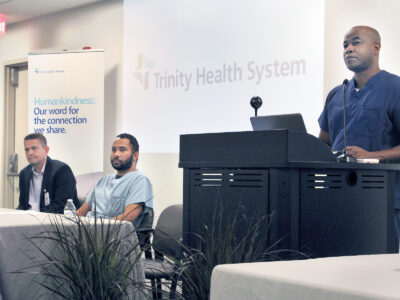
Smith and other medical staff with Trinity Health System announced Wednesday the local hospital now offers an alternative surgical procedure that has proven effective in preventing strokes by closing the source of blood clots originating from the heart.
Smith and Dr. Gregory Suero Abreu, medical director for invasive cardiology at Trinity, said the procedure, known as Left Atrial Appendage Occlusion, involves inserting an implant no larger than a quarter using a catheter extended through a vein in the groin area.
The cut requires two sutures to close, and the procedure takes no more than 40 minutes, the physicians said.
Smith said patients usually are walking within two hours after surgery and able to return home within four hours.
Trinity President and Chief Executive Officer Matt Grimshaw said the procedure is not new, having been performed more than 20,0000 times worldwide, but it hadn't been offered in the Ohio Valley until Wednesday.
Grimshaw said the approach has tremendous potential to greatly improve the quality of life for some patients.
"If you are a patient who needs this, it changes your life," he said.
"This is landmark for this hospital," said Dr. Matthew Colflesh, the hospital's medical director, who said until Wednesday, when the procedure was first performed on Trinity patients, local residents had to travel to Pittsburgh for it.
Smith said 40 other Trinity patients have been scheduled for the procedure.
"That goes to show the need for this," he said, adding he expects 100 will undergo it before this year ends.
Kelly Bettem, cardiovascular service line director for Trinity, said as an Ohio Valley native, she's pleased to be able to offer the service to fellow local residents.
She and others applauded the hospital's administration for supporting the adoption of it and other innovative medical procedures including, last year, Transcatheter Aortic Valve Replacement.
The procedure uses catheters to replace heart valves and as an alternative heart surgery, allowing for quicker recovery for the patient.
Bettem and others said it's part of a team effort by all staff to expand local treatment options for residents of the Ohio Valley.
Smith said, "We want to ensure the patients in this area have access to the highest quality of cardiovascular treatment available."
Abreu agreed, saying, "We want our patients to say, I want to go to Trinity."