
McCafferty says goodbye as police chief
Trending
STEUBENVILLE -- Twenty-one years was long enough, former chief of police Bill McCafferty says.
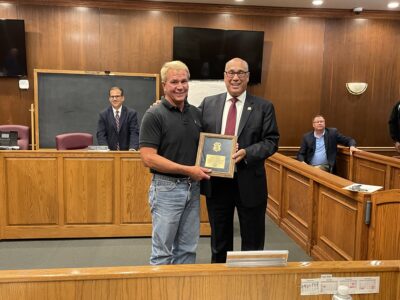
McCafferty officially retired this month after 33 years on the city force, the last 21 in the chief's office. His successor, Chief Ken Anderson, was sworn in Monday.
"I was very blessed," said McCafferty, who graduated from the University of Steubenville in 1984 with a bachelor of science degree in accounting and business/management. "I never lost an officer, I never had an officer have to take someone else's life, and I never had an officer seriously injured. I was very lucky for that."
McCafferty was sworn in as patrolman in 1989, completing the state police academy the following year. He was promoted to sergeant in 1998 and captain in 1999. Then, in 2001 -- four years after the city signed a consent decree to resolve a U.S. Department of Justice complaint that officers had engaged in a pattern of excessive force, making false arrests, improper searches and seizures and more -- he was named acting chief.
"I remember under the consent decree, all those out-of-town reporters coming in saying, 'You look so young to be chief'. I'd say, 'You should have seen me 10 years ago, before all this started'.
"But the consent decree was a game-changer for us, it actually brought us up to modern times with computers, training, weapons. We'd wanted body cams for years but we could never afford them, body cams make complaints so much easier, it is what it is -- either it happened or it didn't happen. That's helped a lot."
He gives a lot of the credit for that to the efforts of four officers, "Capt. Locasio, Sgt. Sullivan, Patrolman Sowers and Capt. Walker," he said. "We all worked together and got through it."
Tumultuous as those times were, "I was the same as chief as I was on patrol," he said.
"I tried to get along with everybody, treat everybody fairly -- treat them how I wanted them to treat me," he said, admitting those years as acting chief were "probably the hardest time (because) I didn't know if we were going to get out (from under the consent decree) or not. But I had a lot of support from my wife and family and I eventually became chief with the blessing of the DOJ."
After two years in office the "acting" was stripped from his title and in 2003 he was sworn in as chief. Two years later, in 2005, the city was released from the consent decree.
He said being chief isn't always easy.
"When you're a patrolman, you just have to take care of yourself," he said. "When you're a sergeant you just have to take care of your turn, when you're a captain you just have to take care of your turn. But once you're chief, everybody's your responsibility. You're subject to phone calls at all hours ... The main thing is, I never wanted to do anything that would embarrass our department and I don't think I ever did. I had to mature quick, but it was a pleasure serving the people of Steubenville and our department, so it was worth it."
He admits there were a lot of cases that bothered him over the years, so many that it's hard to pick just one.
"The rape case, that took a toll because we were accused of hiding things and we weren't hiding anything. From the get-go I wanted to be sure it was investigated properly and it was. But it got legs of its own, and that's where it went."
But he said the most frustrating part of the job "was when there were murders, and I knew people knew who did it and they refused to come forward."
"That's always bothered me, people knowing who killed (someone) and they just won't come forward," he said. "All we need is a little bit to go on and we can solve crimes, but with nothing to go on it's hard."
He's a member of the Ohio Association of Chiefs of Police and the FBI National Academy Association and said a highlight of his 21-year tenure as chief was "getting the opportunity to attend the FBI Academy" in 2015.
He came back to city hall Monday long enough to watch Anderson be sworn in and offer his congratulations.
"I think (his) biggest challenge is going to be finding qualified people to (replace) people leaving," he said "A lot of people around my age are going to be leaving in the next two years. There's going to be a huge turnover. I know the last four (civil service) tests when I was here, we got good people, but there wasn't a big pool to pick from."
But that's Anderson's problem now. The retired McCafferty said he has no set plans.
"I know my dog is going to be happy I'm home all the time," he said. "Other than that, scuba diving trips, just enjoy my life with my family."