Family reflects after long-lost WWII airman identified
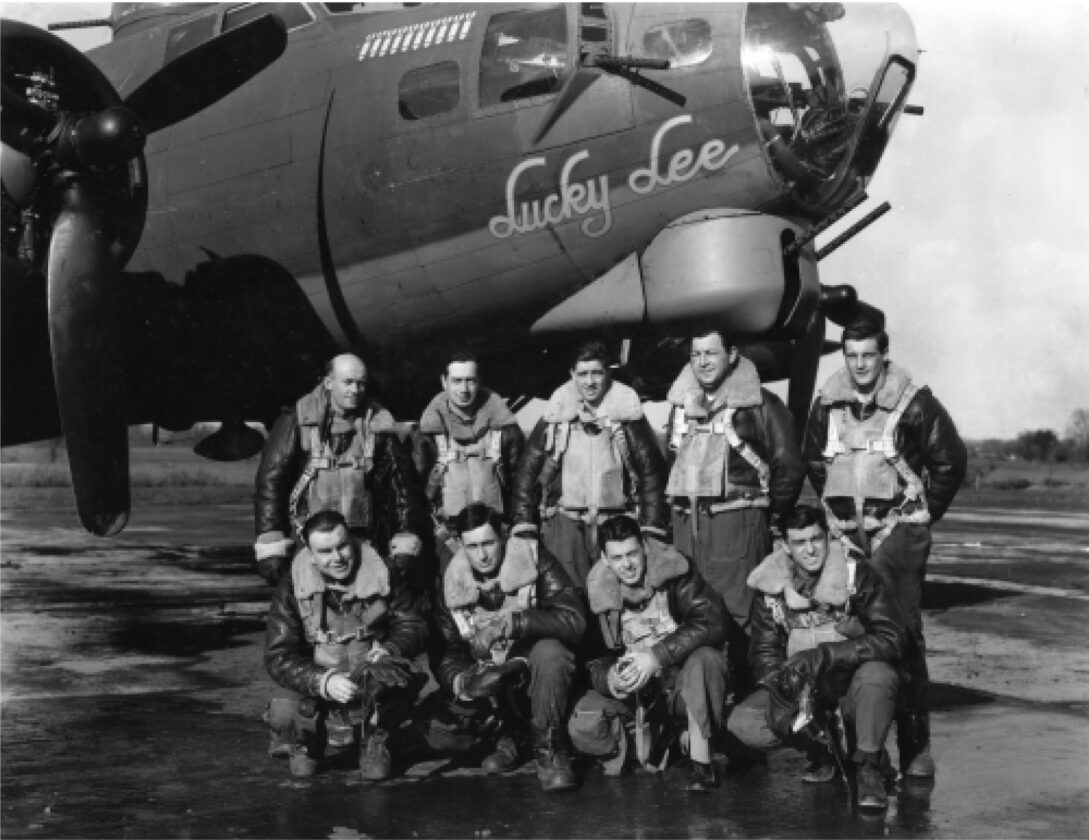
REMAINS IDENTIFIED — The remains of Army Air Force Tech Sgt. William F. Teaff of Steubenville have been positively identified, according to the Department of Defense. Teaff, second from left in the back row, is seen with the crew of the Lucky Lee, his B-17 Flying Fortress, which was shot down during World War II. -- Contributed
STEUBENVILLE — Michelle Lesutis and Amy Sleeman never felt closer to their grandfather, a man they never met, than the day a U.S. military casualty coordinator sat them down for a Zoom meeting and explained, in detail, everything that led to him being buried in an unmarked grave 78 years ago in what is now Lithuania.
“What’s funny is I had this picture in my basement, he’s standing with his crew in front of this plane, the Lucky Lee, and I’d thought it might be a good time to start looking up some history,” Lesutis said. “Then all of a sudden I got a letter in the mail that they had found his remains and they were at a holding center in Nebraska.”
Technical Sgt. William F. Teaff, who was a resident of Steubenville, died in 1944 as a German prisoner of war. His granddaughters are residents of Pittsburgh.
Married just two years when he enlisted to fight in World War II, Teaff, who was 26 when he died, left behind a toddler daughter, Patricia Ann — Michelle and Amy’s mother — in addition to his young wife, Ruth, who was only 18 herself; his parents, Raymond and Bessie; and two sisters, Helen and Ruth. All are now dead.
A member of the 351st Bombardment Squadron, 100th Bombardment Squadron, Teaff was the radio operator on a B-17 shot down over Hannover on a bombing run targeting Berlin on March 6, 1944. Their navigator was killed when the plane was hit, but the other eight crew members were able to bail out before the plane exploded in mid-air. All were captured by German troops and sent to POW camps.
Teaff ended up at Stalag Luft 6 in Heydekrug, Germany, where he contracted diphtheria. He was sent to a hospital in the nearby village of Macikai, Lithuania, where he died on July 10, 1944, and was buried in an unmarked grave with two other American soldiers.
After the war, the American Graves Registration Command, the organization that searched for and recovered fallen American personnel in the European Theater, was unable to recover their remains because Stalag Luft 6 was deep inside the Soviet occupation zone. His name was on a list provided to the Soviet government of missing Americans whose remains were believed to be in their territory but they couldn’t be identified. They tried again in 1950, but that, too, failed, and in March 1954 — 10 years after his plane was shot down — Teaff was declared “non-recoverable.”
But after Lithuania declared its independence in 1992, the U.S.-Russia Joint Commission on POW/MIAs requested the U.S. Embassy in Vilnius look into Teaff’s case: They discovered the Soviet Union destroyed Stalag Luft 6 in 1955 and the area reverted to farmland. In 2006, a team investigated the site and recommended excavation, though significant issues prevented them from sending a recovery team. Around this time, several new sources of information pertaining to the case were located at the National Archives.
The Defense POW/MIA Accounting Agency partnered with Ohio Valley Archeology Inc. in 2019, investigating the sight and finding possible gravesites for the three missing Americans. A Lithuanian archeological group called Kulturos Vertybiu Globa (Guardianship of Cultural Values) was also active in the area and was planning an excavation of Polish and Lithuanian remains near Stalag Luft 6, so DPAA partnered with them to excavate the possible American gravesites in August 2021. The remains found at the site were transferred to the DPAA Laboratory at Offutt Air Force Base, Neb, for analysis.
Scientists used dental and anthropological analysis, as well as material and circumstantial evidence, to identify Teaff’s remains.
“I think it definitely took us by surprise,” Sleeman said. “I didn’t even realize there was a Department of Repatriation that was still investigating MIAs and POWs from World War II. I was shocked and thankful and really excited to be part of it.”
She said her grandfather “has always been part of unknown legend for us.”
“We have a black-and-white photo of him, we always knew who he was,” she said, “but he passed when my mom (was so young).”
Lesutis said one of her biggest regrets is that her teenage self never thought to ask questions.
“My grandmother died when I was pretty young,” she said. “She lived in Steubenville, we lived in Pittsburgh. We didn’t see her that often and when we did, we never got into a conversation about it. I really didn’t even know much about him, to tell the truth. I knew my mother had a different father and he died in the war, but that’s about it. I don’t even think I saw his picture until I was older, after my mother died when my sister and I went through her things. Now I have a picture of him in front of the Lucky Lee and so does my sister.”
What they do have is a box of letters William wrote home to his young bride.
“He was a romantic, he just seemed like an amazing person,” Sleeman said. “I don’t know if (my sister) has had a chance to read them — I’m pretty sure she still has them in her attic, this will be new found motivation for us to dig them out and really reflect on his life and what we know of his life now. One thing I really remember about them was him always asking about my mom, who was a baby at the time, and him being a romantic, always telling her how he missed her, how couldn’t wait to be back, and here he was, this tough soldier going through all these things to survive. He would have been a cool person to have known. So now, having a chance to be part of this important event to bring him home, to give him the respect and burial due him — it’s an honor.”
The sisters have to decide where they want their grandfather’s remains interrred. Right now, they’re leaning toward Arlington National Cemetery in Washington, D.C.
“That’s what he deserves,” Lesutis said, “but I believe the wait on that is about six months or so, but he’ll be buried with full honors. They’re thinking of requesting a fly-by. We think that would be the best way to honor him, people from all over the world come there to honor the dead. I think he definitely deserves it after getting up there and fighting for our country, getting shot down and even surviving (that).”
Two of Lesutis’s sons are in the military and she said the eldest may get to escort his grandfather’s remains to his final resting place.
“Just knowing he’s our blood, that we can do something for him,” Sleeman said. “Myself, my sister, none of our children would be here without him. and also what he did for our country — we get to pay homage for what he did for all of us. It’s an honor — it sounds cliche, but he was always somebody I thought of as a hero. I never knew much about him but now we know, we get to be part of returning some type of honor to him, help bring some type of recognition to him.”
Local News
Commissioners praise jail program’s early success
STEUBENVILLE — Commissioners celebrated the tangible gains recorded from a substance abuse program launched just ...

Two arrested in Brooke County on child neglect charges after 1-month-old’s death

Steubenville Educators Rising chapter going to nationals
Morrisey finishes work on legislation with 12 vetoes, 10 bills not signed
Daily Happenings
Today’s Birthdays April 3 Jenny Jo DeLauder, Bloomingdale Police Beat Steubenville Police Couldn’t hold ...