
Hellbender project gets pitched to DeWine
Trending
STEUBENVILLE -- The Jefferson Soil and Water Conservation district went through a long road to get a proposal to take over a piece of land and protect the eastern hellbender on the governor's desk.
Now, thanks to some help from state Rep. Ron Ferguson, R-Wintersville, Gov. Mike DeWine's signature is the last thing needed for the project to become a reality.
"We've been working on the project for six years," said Mark Nelson, board chair of the Jefferson Soil and Water Conservation District. "It had been four years of red tape, basically, that Ferguson was able to cut through to get it to the governor's desk."
Permission for the governor to transfer the land to the district was included in House Bill 74, the state transportation budget, passed by both chambers of the Legislature in March. The process to get there, though, goes back to the district first beginning to work with the Ohio Rail Development Commission, which currently owns the land which previously belonged to the former Conrail.
The commission received the currently unused 367 acres in the 1990s. A survey process following initial talks with the ORDC took about two years, Nelson said, about four years prior to the legislative action.
Local biologists determined the more than three miles of stream corridor on the property to be one of the largest known nesting sites of the state-endangered salamander in the state, prompting the push to preserve it.
"We see it as an asset to the community to actually have a nature preserve right here in Jefferson County that is able to be managed by local government," Nelson said.
Nelson called the eastern hellbender a "special animal," pointing out it's the largest amphibian in the U.S. and among the largest in the world.
Information on the creature from the district's website says it can grow more than 2 feet in length, weigh more than 2 pounds and lives under large rocks in clean streams.
"It's indicative of clean water because it only lives in areas that have clean water, which is a great thing for our watershed," Nelson said.
He said eggs from the nesting site have been used by the state to help re-populate other areas of the state.
For Ferguson, having the opportunity to have local people heading the conservation of the species' local habitat was a driver in him wanting to help the district.
"When I first talked to Jefferson Soil and Water back in January, they explained to me they had been working on this for five and a-half years," he said, noting they have letters of support from the Franciscan University of Steubenville, the Jefferson County Commissioners and organizations from across the country. "I knew the importance of the project to them. I always say that land is best taken care of in local hands rather than state or federal hands, because local people are able to be there the most often. It's not that the state doesn't mean well with the property, the fact is they just have so much of it and such a big area, where for Jefferson Soil and Water, this will be the heart of the land that they have.
"I think it's a great example of how the legislature can impact the local community."
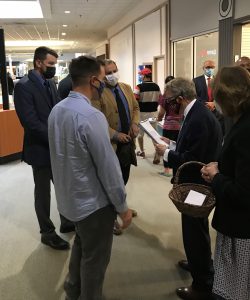
DeWine was asked about the project during his tour of the Jefferson County Health Department's vaccination clinic in the Fort Steuben Mall on Monday. Though he said he could not speak to the project specifically, his comments seemed to echo the sentiment of Ferguson.
"I'm not going to talk about this one, but my general philosophy is that if we have land that can be being used for economic development or other purposes by the local community, we want to free that up," DeWine said. "That is a general principle. This is a state of local government, this is a state of communities. So, the more we can empower local communities, the better off we are as a state.
"If the people of Jefferson County, this area, know this part of the state better, they know the people better ... they're the ones that should be driving all these things."
The Legislature is required to give the governor permission to transfer state land. With the permission from the Legislature taken care of, the governor's office now has three years to execute the transfer.
Nelson and Projects Manager Aaron Dodds were introduced to DeWine by Ferguson on Monday and able to present him information about the project, which, according to Nelson, while focused on preserving the hellbender's habitat, would have four facets -- conservation, education, recreation and preservation.
The land has historical significance beyond the wildlife, an example of which is a rail bridge located on the property that was an early action of Abraham Lincoln's presidency, Nelson pointed out.
"There is a lot of history out on the site," he said. "It's really cool to have that here in Jefferson County."
Dodds noted George Washington visited the property, Col. William Crawford and Gen. "Mad" Anthony Wayne trained soldiers on the land, and Logan the Orator used the land as well.
"The plan by the Jefferson Soil and Water Conservation District will eventually allow for children and adults to access the property and learn about conservation, history and the greater world around them," he said. "An environment will be created where people can stand beneath the towering oak and hemlocks, watch fish swim beneath their feet or walk in the footsteps of Washington, Wayne and Lincoln.
"An environment such as this can have more impact on a life and soul more than anything that can be taught from a textbook."
Dodds noted that talks with Eastern Gateway Community College and the Franciscan University of Steubenville about the education components of the project are taking place, crediting Eric Haenni from the university for helping with the education aspect.
The site also is home to the state-endangered little brown bat.
Dodds noted that the hellbender's presence, through efforts by the district, has brought in more than $889,000 of improvements in the county.
Information from Dodds said the project would work to correct problems from erosion, sedimentation, acid mine drainage, negative effects of unchecked brownfields, illegal dumping and trespassing that have occurred in the more than 70 years the property has sat idle.
A goal, once completed, is for part of the property to be open to the public.
"The JSWCD is greatly indebted to Ferguson for his efforts to bring everyone and everything together to get us to this point," Dodds said, while he, Nelson and the board also credited the Jefferson County commissioners, past and present, and state Sen. Frank Hoagland, R-Mingo Junction, who co-sponsored H.B. 74 in the senate, and the ORDC for their support.
"Our board would also like to thank the hard work of our staff," Nelson added. "We thank the governor for his openness to working with us and for consideration."