
Testimony underway in murder trial
Trending
STEUBENVILLE -- Cheryl Reid struggled to maintain her composure Tuesday as she told jurors tasked with deciding the fate of accused murderer Jason Twiley about the last time she saw her daughter, Brittany Littlejohn, alive.
It was Aug. 10, 2019, two days before her daughter’s body would be found, naked and stuffed headfirst in a garbage can in a garage on Maxwell Avenue, covered only by a red sheet.
“We all were just sitting around, minding our business, playing with the kids, cooking,” Reid recalled. “Brittany drives up all distraught and says, ‘Mom, he won’t leave me alone. I want him to leave, Mom. I want him out of my house.'”
On Tuesday, the second day of Twiley’s trial in Jefferson County Common Pleas Court, Prosecutor Jane Hanlin called 15 witnesses to the stand, seven of them friends and family members who painted a portrait of Twiley, 28, as a jealous, possessive, violent man.
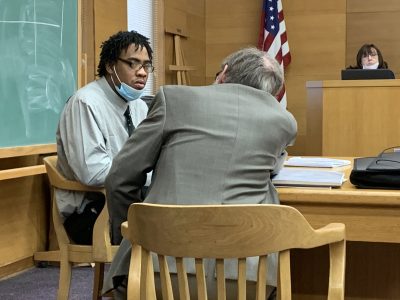
Twiley, 28, is on trial for murder with a firearm specification and aggravated arson.
Authorities allege he shot Littlejohn, 32, with a 9 mm handgun, put her in the trash can and dragged her body to a garage a few doors away, then used gasoline to start three separate fires in her home in hopes of destroying the evidence. They maintain he fled Steubenville in a car he’d borrowed from Caitlyn Hinkle, a Weirton woman, for $100 and some crack cocaine, hiding out for a time in Chicago before being arrested by U.S. marshals in Louisville 39 days later.
Reid, the first family member to take the stand, told Hanlin she’d lived with her daughter and Twiley for a time, recalling for her several occasions when she heard the two of them arguing. On one of them, “He walks up the steps saying, ‘I murds people, I don’t give a f***. I murds people,’ then he walked in the bedroom,” Reid said.
“When he says ‘I murds people,’ what did you take that to mean?” Hanlin asked.
“He murders people,” Reid replied.
She said Twiley would fly into a rage over Littlejohn’s “cozy” - her daughter’s name for a blue dress she invariably reached for when she came home from work.
“She would work 12-16 hours a day, and when she came home, she wanted to relax,” Reid said, “(But) he said it was too revealing, that he didn’t know who she was trying to dress up for. He’d say, ‘You’re cheating on me, I know you’re cheating on me.'”
Reid said she moved out of Littlejohn’s home on orders from Twiley, telling Hanlin she’d called her daughter to beg her to get Twiley out of her life and he happened to be with her.
“I could hear him in the background saying things to her and she said, ‘Mom, this is who I want to be with, you can just leave,'” she said. My daughter would never tell me to leave. I could hear him in the background. What she told me was what he said (to her).”
Two days before her daughter’s body was found, Reid said she shot a video of Twiley slashing her daughter’s car tires.
“She’s walking toward the back door, (he) came along through the alley, a brick in one hand and he had one of those folding chairs … He laid it up against the car. He said he wanted something from her. He was claiming she owed him money for some bill, she’s objecting because they both live there. He got angry and said he was going to bust her car up. I said, ‘Brittany, if he busts your car up, I’m recording it.'”
Twiley, she said, told her he “didn’t give a f*** about no police, blah blah blah.”
“I guess he could call himself being a man,” Reid said, disparagingly. “He walked up the street, nobody else paid him attention. Brittany stayed at the house for a while and played with the kids. When I say she played with the kids, she played with the kids. Then she said, ‘Mom, I’m going to go home and take a shower.'”
She said she asked Brittany if she wanted company. “She said no, I’m tired. I’m going home to take a shower. I got this, I got this.”
Reid, trembling, told Hanlin she tried calling her daughter’s cell phone later but there was no answer.
“Did you ever see your daughter again after that?” Hanlin asked.
“No, I didn’t,” Reid replied. “The last thing she said to me was, ‘I’m going home to take a shower, I got this.'”
Later, she said Twiley walked back to her house and asked her to help him get the car fixed, telling her, “Brittany needs it to get back and forth to work.”
“I told him no, if he hadn’t slashed the tires he wouldn’t have that problem,” Reid said. “So, I said where’s Brittany at, he said he gave a friend $20 to take her to work.”
Reid said she knew something was wrong when her daughter didn’t answer, saying it was “very unusual … If she didn’t answer the phone, she’d always call me back when she sees I called. She wouldn’t hesitate to call me back.”
“I called her phone, I kept calling and calling, never got an answer,” she said, telling jurors she walked over to her daughter’s house when she knew Twiley wasn’t there, but the front door was dead-bolted so she couldn’t get in.
Littlejohn’s sister, Brandi Ross, recalled hearing the two of them arguing over $200 to pay the gas bill, telling jurors, “I heard him say he wanted to kill her.”
Ross said she feared for her sister’s safety, adding, “I always told Jason, whatever you do, do not hurt my sister. Don’t do anything to hurt her.”
“Why did you feel you had to have that conversation?” Hanlin asked.
“He portrays as that kind of person,” Ross replied, telling jurors how Twiley tangled with her best friend a few days after her daughter’s birthday party. “My sister tried to break it up and he choked her, then he let her go.”
Twiley’s attorney, Gary Levine, keyed on Ross’s insistence that she’d heard his client say, “I want to kill (Littlejohn)” during the argument over the gas money.
“Did you tell your mother Jason threatened to kill your sister?” he asked.
“She was there,” Ross replied.
“She testified,” Levine responded. “Would it surprise you to learn she didn’t mention it?”
“As I mentioned to Jane, (Mom) was trying to calm Brittany down, I was trying to calm him down,” Ross rejoined. “We were in different rooms.”
She also told Levine the altercation with her friend started when the friend “told my sister, Brit, he was cheating on her and (Twiley) didn’t like that.”
Longtime friend Helen Terry, said Littlejohn had sheltered with her in Pittsburgh for five days earlier in August “because she knew it was a safe place.”
She said at one point, the two of them and her boyfriend were watching TV when Littlejohn “asked my boyfriend if he could turn the TV down.”
“I asked her what the problem was,” Terry recalled. “She said her eardrum was busted … She said Justin had (punched) her in the side of the face.”
Another time, she said Twiley wanted to know when Littlejohn was coming home. Littlejohn had her phone on speaker, and Terry said she could hear every word that was said.
“She told him she didn’t know because she didn’t know if he was going to do anything to harm her,” Terry recalled. “He said he was hungry. She said there was food at the house.”
On cross examination, a hostile Terry told Levine, “She was with me because she was afraid of the defendant,” Terry said, bristling when he asked her to pinpoint when police called her in for an interview. “I actually asked them to call me as a witness.”
Earlier in the day, various witnesses described finding what appeared to be blood at the scene as well as other items, including a blood-soaked laundry basket, blood-stained clothing, an empty bleach bottle, gas cans and cigarette butts.
BCI Special Agent Ed Lulla told the jury he collected a number of items that could conceivably carry DNA, including a cigarette butt left in the garage with a stash of items that hadn’t been there the day before, and had to decide merited testing.
The cigarette butt, he said, “appeared to be very fresh.”
“It wasn’t dirty, as if someone had stepped on it,” he explained. “In my opinion it was recently left there.”
He said at some point, he was redirected to a garage at 429 Maxwell Ave. where Littlejohn’s body was found.
“There was a trash container (in front of the garage) and behind that a mattress,” Lulla said. “Behind the mattress there was another Steubenville trash container. I believe it was Chief McCafferty who opened it up a little, I believe he saw a body.”
Several members of Littlejohn’s family and friends cried quietly, clutching tissues and each other when Hanlin showed jurors photos of the crime scene, including one of Littlejohn’s body, stuffed inside the trash can.
Lulla said when they discovered a bullet wound on her left side, he returned to Littlejohn’s residence in hopes of finding a casing. He said he found a box of ammunition in the dining room, but no spent bullets.
Levin questioned Lulla at length about his DNA methodology and asked him why he hadn’t tried to gather fingerprints from garage door handles, trash cans and other items.
“I can look at an item and tell you whether there are going to be fingerprints or not with at least 99 percent accuracy,” he said. “there was a much, much, much better chance of recovering DNA than fingerprints. I’ve gotten DNA off of textured gaskets - never in all my years at BCI have I gotten fingerprints off gaskets.”
Levine also questioned why, when it was apparent someone had walked through blood at the crime scene, none was found in the car Twiley had borrowed from Hinkle.
Before the jury was brought into court Tuesday, Twiley dithered for nearly an hour on whether to plead guilty to murder and aggravated arson in exchange for a recommendation that he be sentenced to 15-years to life in prison.
“Right now, you have an option,” Judge Joseph Bruzzeze Jr. told him. “If you go to trial, you stand the chance of an additional 11 years - three years for the gun specifications, eight for the arson. Of course, if you’re found not guilty you get to go home and eat dinner.”
Twiley eventually elected to proceed with trial. He’d asked Bruzzeze to appoint new counsel, but the judge declined, telling him, “(He) knows the case. I’m not going to appoint someone who doesn’t, that would be stupid.”
“Quite frankly, if I saw (him) doing something wrong I would,” he said. “But I don’t see anything wrong with his representation.”