
Franklin enters plea deal in court
Trending
STEUBENVILLE -- Former Diocese of Steubenville comptroller David Franklin agreed Monday to help prosecutors build a case against others who may have benefited from lax financial oversight within the diocese prior to his retirement.
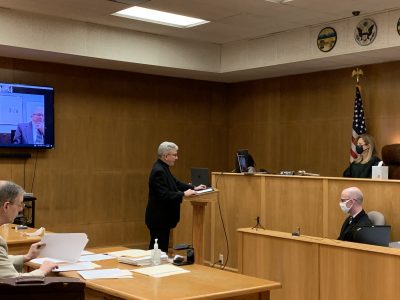
As part of his plea deal Franklin, 69, was sentenced by Jefferson County Common Pleas Judge Michelle Miller to 18 months in state prison and ordered to make $532,115 in restitution, but prosecutors say he'll do the first 366 days of his sentence in federal prison and then serve the remainder at a state facility. In the event his federal sentence is altered or vacated, Franklin will immediately report to the state prison.
Assistant Prosecutor Frank Bruzzese said Franklin will provide "testimony, documents and a debriefing" as part of his office's ongoing investigation into whether others had benefited from the financial misconduct he'd admitted to, which spanned nine years beginning in 2008.
Bruzzese said Franklin will help them "sort out what, if anything, was criminal mismanagement and what was theft ... how maybe four or five other people were getting such what I would call 'ungodly' bonuses over the years."
Of the 40 or so diocesan employees who received bonuses during a 14-year period, Bruzzese said most were for minor amounts and easily explained, "but of four or five people who got (them), ... one got $180,000, another about $221,000 and one about $128,000."
Franklin admitted paying himself nearly $300,000 in performance bonuses he hadn't earned, and failing to report the illicit income to the Internal Revenue Service. He also failed to turn over payroll taxes he'd collected from employees of the diocese, the Office of Social Ministry and the Mount Calvary Cemetery Association, costing the diocese an additional $999,713 in interest and penalties that were assessed by the Internal Revenue Service when it covered the nearly $2.8 million payroll tax debt plus the employer portion of the tax.
Bruzzese told the judge Franklin had diverted money intended for legitimate diocesan purposes to pay himself and a select group of employees unauthorized bonuses, falsifying records to conceal the true financial condition of the diocese. He said the diocese had moved its operating funds from Chase bank to PNC in 2010 but, unbeknownst to higher-ups, the Chase account wasn't closed.
Bruzzese repeatedly referred to the secret account as a slush fund, telling the judge, "No one else knew it existed. It was off the books." Funds diverted to it were used to pay "substantial bonuses to a select group of friends unauthorized bonuses on top of their salaries."
Bruzzese told the judge Monsignor Kurt Kemo, the former chief financial officer of the diocese, was vested with plenary authority over diocesan finances, adding "all these checks" were signed by Kemo, "raising questions about whether Monsignor Kemo is also exposed to liability for criminal conduct in the case."
Kemo resigned May 26 as pastor of Blessed Sacrament and Our Lady of Lourdes parishes in Wintersville and was given a leave of absence from pastoral ministry. At the time, the diocese referenced "the scandal caused by financial irregularities in the Diocese of Steubenville" during his tenure as vicar general and chief financial officer.
"It may appear to some that 1.5 years in prison is a lenient sentence, but we ... considered a variety of factors," he said, ticking off a list that included Franklin's lack of prior offenses and the lack of oversight during his 32-year tenure as comptroller. He said there was "no evidence" an audit or independent review had been done for years prior to Franklin's retirement.
"We need Mr. Franklin's help to continue the investigation, in order to clean up all of the financial affairs and get a clear understanding of what happened to all of the money," Bruzzese said, adding the sentence was crucial to "the cause of justice and satisfying the concerns of parishioners. We need to get to the bottom of it."
Franklin's attorney, Robert McBride of Taft Stettinius & Hollister, said though Franklin bears responsibility for the financial mismanagement and embezzlement, "it can't be put at (his) feet entirely." He said Franklin "didn't have the authority to keep an off-the-books account, he didn't have the authority to pay bonuses."
Bruzzese said he and McBride "definitely have a passion for looking further into who needs to pay for this financial mismanagement."
"Neither of us believes the defendant is solely responsible," he said. "One thing is clear, we need to investigate further and Mr. Franklin can help us."
For his part, Franklin said he considered himself "a loyal employee."
"I never signed any of those checks," he said. "Basically, I followed what Monsignor Kemo advised me to do. I do recognize I was negligent in a lot of things and I'm sorry for that - basically, I had an unsupervised position."
After the hearing ended, Bruzzese said they'd noted "thousands and thousands of dollars" in questionable charges on diocesan cards.
"We know most of the answers already," he said. "We'll see what usable testimony and documents we get from the debriefing, and we should be able to wrap this up very quickly."
Bishop Jeffrey Monforton said he had "mixed feelings" about the plea, pointing out a "lot of damage has been done."
"There was malfeasance in office and it had a direct effect on our ability to serve our neighbors," he said. "This is not what we're about."
He said what's most important "is regaining the trust" of parishioners and the community, adding healing would take "a lot of prayerful work."
"You forgive but still there are going to be consequences," he said. "You're not going to say it's water under the bridge - but God always forgives and so should we."