
Students to learn about possible fate of original Fort Steuben
Trending
STEUBENVILLE -- Fourth-graders around the Ohio Valley can learn about a history a little closer to home when they resume studies this year.
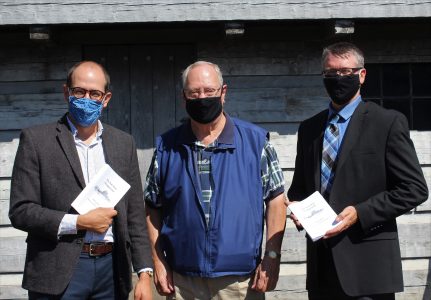
Local resident Andrew Celestin and Steubenville native Hunter Boylan co-authored "The Fort That Disappeared" about the suspected fate of Historic Fort Steuben in Steubenville and are donating nearly 100 copies of the 10-page booklets to schools around Jefferson, Belmont, Harrison and Columbiana counties. Efforts to re-establish the current Fort Steuben began in 1986 and the facility was completed in 2009 near the Market Street Bridge, where it since has hosted tours and musical events to the annual Frontier Days and Nutcracker Village celebrations. Celestin, a volunteer and treasurer for the Fort Steuben Board of Directors, and longtime friend Boylan, a retired professor at Appalachian State University in North Carolina, collaborated on the publication when the educator recently paid a visit to the landmark.
"Dr. Boylan's from the area and returned to visit family last fall," Celestin said. "He had never seen the fort and thought there was a story there. We met [Executive Director] Paul Zuros for a three-hour tour and Hunter asked questions and took notes, then he went back to North Carolina and started writing and researching."
Boylan, who retired after nearly 40 years in education and most recently served as director for Appalachian State's Reich College of Education's National Center for Developmental Education and professor in the Reich College of Education's Department of Leadership and Educational Studies, has authored seven books and about 120 articles and counts himself as an amateur historian.
He collaborated with Celestin, Zuros and Philip Fitzgibbons, professor of anthropology and director of the anthropology program at Franciscan University, to gather details and craft the piece and the publication was completed this spring.
"I was planning to write an article for Military Quarterly on the Civil War in the South and said, 'Why not write one on Fort Steuben instead?' I learned a lot about the 1st American Regiment and their battles with Native Americans in the Ohio Territory," Boylan remarked. "While researching the piece, I discovered a lot about the area. The soldiers stationed at the fort were the first Army after the American Revolution."
The article focuses on what happened to the site, which was established along the banks of the Ohio River in 1786 as a winter camp for the 1st American Regiment of the U.S. Army. The soldiers were tasked with protecting surveyors sent by the Continental Congress to map the Northwest Territory and also removing squatters and illegal settlers. The fort was later abandoned, and although there was speculation that it burned down around 1790, research indicates it may have been dismantled and the materials reused for new settlements. An archaeological dig performed by Professor Fitzgibbons and Franciscan University over the past 30 years showed no significant signs of a blaze but seemed to suggest that travelers heading downstream possibly used the abandoned fort as a temporary resting place and hauled away the wood for other uses.
"We suspect that some of it was used as firewood for campsites or the buildings were taken apart and the notched logs were towed downriver behind the flatboats and used to build cabins," Celestin commented. "There's a whole lot of additional history attached to Fort Steuben in Dr. Boylan's research and he's found a lot that's left wanting."
Meanwhile, Zuros agreed with the synopsis.
"We feel -- and it's my opinion -- that the fort was carried out for raw material after the Army moved out. (The site) was abandoned in April of 1787 and we don't know when it disappeared," he said.
Zuros was excited to see the landmark included in present school studies.
"We're trying to keep the history alive in Steubenville and Jefferson County. The more people who come down and tour and take part in history, the more it makes our history relevant. We're just really excited this publication is going to be sent out to fourth-graders and the students can learn how it may be a small area but plays a part in our national history."
Celestin and Boylan hope teachers include the information as part of their Ohio History studies and students realize there are intriguing connections in their own backyard.
"We're losing history and want to help gain some history back," Celestin noted. "I'm really proud of the booklet, and if it could be used to help teachers augment their textbooks I'd be really tickled."
Celestin has been involved with Fort Steuben for 29 years as a master carpenter and helped rebuild forts and furniture to bring its history back to life. His son Scott, an assistant superintendent for Buckeye Local Schools, contacted the Jefferson County Educational Service Center to help distribute the booklets to area schools.
JCESC Superintendent Chuck Kokiko said it would be a great addition to student learning.
"One of the roles of JCESC is to serve as a conduit for information to our schools and students. I was excited about the opportunity and began reaching out to schools in the surrounding community," Kokiko explained. "Teachers are always looking for ways to add to their subject or grade level. In most cases, nationally created textbooks and curriculums often lack local content. The booklet on the fort is a great example and fits well into the fourth-grade Social Studies which specifically addresses Ohio's history. I would like to thank Mr. Celestin for his generosity and reaching out to our schools for the benefit of Ohio History and the education of our students. We are glad we were able to assist in making his book available to our schools."
JCESC collaborates with school districts in Belmont, Harrison, Jefferson and Columbiana counties including Bridgeport, Buckeye Local, Edison, Harrison Hills, Indian Creek, Jefferson County Joint Vocational School, Steubenville, Southern Local and Toronto City Schools. For more information about Historic Fort Steuben, call (740) 283-1787 or go online to oldfortsteuben.com.