
Not to be forgotten
Graver marker dedication service today at Two Ridges Cemetery remembers special Union soldier
Trending
WINTERSVILLE -- Martin Kean died 156 years ago, but today he'll be remembered anew during a service at a local cemetery.
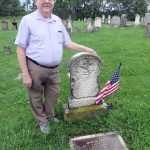
A new grave marker for the Civil War soldier buried at Two Ridges Cemetery in Wintersville will be dedicated at 11 a.m., following the 9:30 a.m. worship service at Two Ridges Presbyterian Church, located at 1085 Canton Road.
Open to the public, the service will involve remarks by the Rev. Bill Lawrence, the church's pastor; some insight on who Kean was, courtesy of history buff Alan Hall, the church's clerk of session; how two cousins pursued getting a new marker; and the participation of representatives of the Stevens-Christian Memorial American Legion Post 557, Wintersville.
Though the dedication comes on the heels of Memorial Day, the timing is mere coincidence, given the process to properly acknowledge the final resting place of the Union soldier began more than two years ago.
"It took two and a half years from start to finish," Hall said.
"We were just hoping to get it done sometime."
Pvt. Martin Kean of the 9th Michigan Cavalry was wounded in the Skirmish of Two Ridges on July 26, 1863, as the Union forces were attempting to capture Gen. John Hunt Morgan, whose Confederate forces had entered Ohio. Kean was cared for by a Wintersville family, but died a month later on Aug. 27, the only death of the military effort.
He was buried in Two Ridges Cemetery in the Coe family plot. As the years wore on, so, too, did the deterioration of his monument grave marker, which could no longer be read. To the casual observer, the inscription of a flag to suggest military involvement had all but vanished.
Memorial Days would come and go with flags placed on the graves of other veterans, save for Kean's. It was a point Hall would ultimately make to fellow church member Greg Williamson.
"I said to my friend Greg, 'You know, they don't put one on his, probably because it doesn't have the marker anymore,' and he said, 'Let me see if we can correct that,'" Hall said.
Such put the wheels in motion for Greg Williamson and his cousin, Jim Williamson of Columbiana, Ohio, to pursue obtaining a new marker through the Veterans Administration, a process that involved submitting an application and addressing some confusion over the correct spelling of Kean's name. Hall said the marker almost looks like the name is spelled Cane, but the debate included Kean and Keane as other versions.
"Finally the veterans affairs folks said, 'It's Kean on our record, and that's the only way we can produce the marker,' and I said, 'I think Martin would be pleased,'" Hall said.
The new veteran's marker is in front of the 1863 marker to now identify Kean's grave.
"I don't think we've been able to read his marker for some time," Hall said. "There were marker readings done in 1940 and 1996. The 1940 lists it, but 1996 I think it just says soldier because you could still see the flags."
That Kean was buried in the Coe family plot, an older part of the cemetery that families once dealt with, not the church, apparently meant the VA needed permission from a Coe family member, according to Hall. Ken Dornbush, a member of the church and a Coe family descendant, "wrote a nice letter, and they said this will be acceptable, and so Martin got his marker."
Hall glanced at Kean's grave.
"I keep thinking he was only in the United States less than a year and did his parents even know what happened to him? He was 20 years old," Hall said.
The actual skirmish took place from where King's Restaurant is today along Two Ridges Road where the Coe farm was located at that time. Kean had been a member of the 9th Michigan Cavalry since April 28, 1863. He had arrived in New York City as an immigrant from England, where he was born in Liverpool in 1843.
His commanding officer was Gen. James M. Shackelford (1827-1909) who was involved in the capture of Morgan at West Point, Ohio, (Columbiana County) shortly after the Two Ridges Skirmish.
Kean's death was the only death that took place in the "Skirmish of Two Ridges" during the era of Morgan's Raid, the only incursion of Confederate forces into Ohio during the Civil War.
He survived about a month after the skirmish and was cared for by the Coe family, who allowed him to be buried in their family plot in the cemetery.
A small committee from the church worked on the grave marker project with research by Erika Grubbs in the Local History and Genealogy Department of the Schiappa Branch of the Public Library of Steubenville and Jefferson County.
"There is a wonderful essay that appeared in the Herald-Star on May 29, 1913, on the 50th anniversary of the event," Hall said of the historical narrative by the late Ross Coe, who recounted the skirmish. Coe was 13 and right in the middle of the action at the time. The story details how Kean lived for a month following his wound and was cared for at the Coe home by Ross' parents.
"In 1863 I was a 13-year-old boy living on the Richmond road near the Two Ridges Church, in the green house on the hill where Wade Stevenson now lives. I well remember Morgan's Raid that passed our place on Saturday afternoon, July 25th. We understood they were heading for Steubenville. My father, Benjamin Coe, had ridden our best horse to town that forenoon. About 2 o'clock we heard Morgan's men at Wintersville and coming our way. They soon came up the road.
"A few not more than 50 stopped around the house and barn while the others jogged along toward Richmond. Mother and Aunt Jane Nicholls and about six children were on the front porch. The raiders politely asked for water and something to eat. Mother soon gave them all the bread and butter about the house. They told the women to go in the house and shut the door as there was going to be some shooting done around there; it would be better for them to go in the woods over the hill. They took the children and went down in the woods and stood in the entry of a coal bank. Morgan's men made a pretense of a fight from our house and barn to gain time.
"The militia came on the opposite hill about 100 rods from our barn ahead of Shackelford's men. They fired three or four times at the barn with a cannon they had; one load was with pieces of iron, some roller balls from a hay press that stood in Morton's meadow and other junk. We found the missiles about halfway to the barn.
"The barn was not touched, except perhaps a half dozen miny ball holes. There were two bullet holes in the house. Shackelford's men soon came up and passed the militia.
"Martin Kean of the Michigan Calvary was fatally wounded. He was in the middle of the road about 80 yards from our front gate. While stopping to shoot under his horse's neck, a minnie (sic) ball struck him under the collar bone and came out near the middle of his back. He said the man that shot him stood in the gate and shot about a second too soon for him. He was carried to our porch and lived until Aug. 27.
"Nelson Carney of the Michigan Calvary was about 140 yards behind Kean and was shot in the thigh. He and Wm. Page, one of Morgan's men, was taken to Grandmother Coe's house where we now live. Page was shot through the cap of his right knee. He was a nice looking boy about 18 years old from Kentucky. He was shot with a small bullet. They cut a minnie (sic) ball out of Carney's thigh.
"There were two horses killed and three wounded ones left on our place. They left two horses to care for the wounded, Hark Warner at our house, and Milo Randal at Grandmother's, both from the Michigan Calvary. Warner's horse was killed. Randal kept his dun horse and bugle with him and often gave me some good loud music. Dr. Markel of Wintersville dressed the wounds and cared for the men. Carney and Page stayed until Kean died. Then Carney got a furlough to Michigan and Page was sent to Fort Delaware.
"I was sitting beside Kean the evening of Aug. 26th while the others were eating supper. I noticed blood on the wound and called the nurse. Kean said, 'Oh, God, it is all up with me.' He bled inwardly and died about three o'clock that night. He was buried in the Two Ridges cemetery. Mrs. Martha Lyons raised money and had a good substantial stone put with the inscription 'Martin Keane, born in New York 1842. Private of Co. F. 9th Michigan Cavalry, wounded by Morgan Raiders July 25, died Aug. 27, 1863.'
"Alfred Dougherty and Orvid Nicholls, boys about my age, were with me and saw about all the procession from behind the trees and fences near the church. Morgan's men were dressed in all manner of style, dress coats and ragged pants stove pipe hats and no shoes, others with good citizens' suits; all kinds of horses and saddles, some riding big fat farm horses that looked as though they were not far from home. One was riding a bay mare they took from our pasture. I told him that was our Nell mare. Father got her the next week in a pasture near where Morgan surrendered.
"Ross Winters had three good horses taken out of his barn, two of them he never saw again. Mr. Plummer lived a mile off the road. He got on a good $200 horse and come out on the road just as Morgan's first men came over the hill. He turned his horse to go back but they stopped him long enough to trade horses. A Dutchman was hauling in wheat with a good team. After they swapped with him, he said, 'I vish mine horses good luck. I vish they break your necks.'
"When mother came back to the house Shackelford's men were at the well for water. She had left the doors open when she went away and there was nothing disturbed, no sign of anyone being in the house. Morgan's men had a city cab with a fine team and silver mounted harness and a colored man driving with them. It passed within 20 feet of where we stood by the fence.
"After Carney and Page got able they spent part of their time playing cards together. One day a man came in and after talking to Carney he turned and asked Page where he was shot. He said through the knee. The caller replied, 'It is a pity it was not through your heart.' Carney swore if it was not for his game left he would kick the man out of the yard for talking that way to a wounded prisoner.
Kean's obituary in the Sept. 2, 1863, edition of the newspaper noted, "Kean's wound was a severe one. The ball passed through his breast, through a portion of one of his lungs and out near his backbone. That he survived an hour after receiving his wound was the marvel of his surgeon as well as all who saw him. In his sickness, every aid that care and kindness could bestow was extended. Now that is he gone, he will be held in grateful remembrance by every true patriot."
Hall said there are rumors that a Confederate soldier is buried in Two Ridges, but that's not so.
"Kean is the only person related to Morgan's Raid buried there."
(Kiaski can be contacted at jkiaski@heraldstaronline.com.)