
BLACK HISTORY
In celebration of Black History Month, we are saluting area black leaders who have made or are making an impact in our local area.
Grace Murray was born in 1885 in Springfield and resided most of her life in Steubenville. She became the first black matron of the Steubenville Police Department and was the first black to serve on the community’s board of health. She helped to organize the Americus Democratic Political Club in Steubenville during the early 1940s. This organization was the first formulated to involve blacks in politics in Jefferson County. In 1948, President Harry S. Truman invited her to his inaugural ball, where she danced with the president.
BLACK HISTORY
In celebration of Black History Month, we are saluting area black leaders who have made or are making an impact in our local area.
Steubenville Big Red’s outstanding trio in the early 1950s was Eddie “Punkin” Vincent, Calvin Jones and Frank Gilliam. All three left Steubenville and played at Iowa University together. They were the first group to make their mark in Iowa, which made other colleges from the conference look to Steubenville City Schools for other outstanding athletes. Vincent went to the Los Angeles Rams professional team and served as mayor of Ingelwood, Calif. He was a member of the California Legislature. Jones went to work for a Canadian league and is deceased. Gilliam went on to play for the Minnesota Vikings and is a senior consultant for player personnel for the team.
BLACK HISTORY
In celebration of Black History Month, we are saluting area black leaders who have made or are making an impact in our local area.
Barbara A. Wilson began working at the Jefferson County Regional Planning Commission in 1974 as a secretary. In 1992, she was appointed interim director, and in December 1993, she became the permanent director of the commission.
BLACK HISTORY
In celebration of Black History Month, we are saluting area black leaders who have made or are making an impact in our local area.
George Moore was involved with Local 1190 of the United Steelworkers of America in the 1930s and 1940s. He assisted H. James Baker in attempting to organize a union at Weirton Steel Corp.
BLACK HISTORY
In celebration of Black History Month, we are saluting area black leaders who have made or are making an impact in our local area.
Dr. Clifford C. Morton became a dentist in Steubenville in 1921. He graduated from Steubenville High School and Howard University. He later moved to Cleveland to practice dentistry.
Black History
In celebration of Black History Month, we are saluting area black leaders who have made or are making an impact in our local area.
– George “Speedie” Hopkins Jr. was granted permission by the Steubenville Council in 1984 to paint the first mural of the Market Street Bridge in the Market Street Mini Park. Hopkins is employed in Oakland, Calif., as a computer graphic design specialist.
BLACK HISTORY
In celebration of Black History Month, we are saluting area black leaders who have made or are making an impact in our local area.
James Hubbard was elected second vice president of the Steubenville Kiwanis Club in 1995. He was elected first vice president in 1996 and 1997 and was the first black man to serve as president of the club.
BLACK HISTORY
In celebration of Black History Month, we are saluting area black leaders who have made or are making an impact in our local area.
Dennis Palmer Jr. served as the first black administrator on the board of advisers and was supervisor of the Steubenville post office. He was elected to the Steubenville Board of Education, served as jury commissioner in Jefferson County and was director of financial aid at the Franciscan University of Steubenville. He died July 15, 1995.
BLACK HISTORY
In celebration of Black History Month, we are saluting area black leaders who have made or are making an impact in our local area.
H. James Baker was the first black to become involved in Local 1190 of the United Steelworkers of America in the late 1930s and 1940s. He was the first black to chair the Local 1190 grievance committee.
In 1956, Baker, along with Byrdie Owens and Patricia Fletcher, integrated the Wheel Restaurant and other local restaurants. Baker also was a strong supporter of the local branch of the National Association for the Advancement of Colored People. He became a national advocate in 1926.
Black History
In celebration of Black History Month, we are saluting area black leaders who have made or are making an impact in our local area.
The first black detective for the Steubenville Police Department was Ross Mike. He became patrolman in 1953 and served as a detective from 1955-1979.
Black History
In celebration of Black History Month, we are saluting area black leaders who have made or are making an impact in our local area.
LaFayette R. Mercer was the first black member of the Steubenville Police Department. He died in 1911.
BLACK HISTORY
In celebration of Black History Month, we are saluting area black leaders who have made or are making an impact in our local area.
Lowena D. Fletcher was the choir director at Quinn AME Church, and she was paid by the government to start choirs in area churches, including in Smithfield and McIntyre. She also was instrumental in beginning the first choir at Mount Zion Baptist Church. She was the wife of Albert C. Fletcher and the daughter of the late Thomas and Geneva Ford. She had six children and worked at the Jefferson County Courthouse. She died on March 1, 1989.
Black history
In celebration of Black History Month, we are saluting area black leaders who have made or are making an impact in our local area.
James A. Fletcher II is vice chancellor of administration at Texas A&M University. He is a graduate of Steubenville High School who has held a number of executive assignments, including vice chancellor of finance and administration at the University of Colorado, as well as positions at Howard University, IBM Corp. and GE. He holds degrees from MIT, Fairleigh Dickinson University, the College of Wooster and a law degree from LaSalle, as well as an master’s degree from Harvard, with high distinction and designation as a George F. Baker Scholar. He is the first African-American ever to earn the designation. He worked as a White House Fellow in 1973-74 in the executive office of President Nixon. He is the son of Edna K. Fletcher and the late Howard B. Fletcher.
BLACK HISTORY
Delores Wiggins of Steubenville, a longtime leader in the African-American community, is president of the Upper Ohio Valley Black Caucus. She also is the director of the Martin Luther King Jr. Choir and president of the Steubenville Civil Service Commission.
Black history
As the longtime director of the Steubenville Striders, Patricia Herring, Franciscan University Class of 1975, has mentored and coached hundreds of youth who went on to state championships at the high school and college levels in track and field and long distance running.
Black History
In June 1965 in Mingo Junction, the Spinner family, including Jasper L. and Barbara Jean, along with their children, Crystal, Craig, Charisse and Carleton, challenged the town’s segregated public swimming pool rule that existed at Aracoma Park. This was a period in America’s history where segregation and discrimination did not even spare the town and the public swimming pool. The Spinner family overcame this prejudice and despite opposition from both black and white neighbors, fought and successfully de-segregated the town’s public pool. Jasper L. Spinner died in an accident, while at work in Wheeling-Pittsburgh Steel on Oct. 7, 1965, but not before realizing his dream of seeing his kids being able to swim in the town’s public pool.
Local News
One dead following incident at Marshall County mine
A miner was killed after suffering head and neck injuries in an incident at a Marshall County mine Friday ...
W.Va. Citizens Action Group files intervenor motion against DOJ effort to obtain voter records
CHARLESTON - An advocacy group is seeking to intervene against efforts by the U.S. Department of Justice (DOJ) to ...
Community Briefs
Farm Fest on tap BLOOMINGDALE — The County Road 39 Farm Fest has scheduled its 2026 Summer Bash & Cruise-In ...
Hope still lives in our hearts
Most authorities agree that a missionary, Mr. Roberts, first introduced the lovely Bermuda Easter lily, which so ...
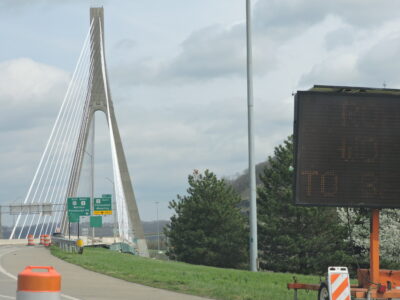
Work begins Monday on Veterans Memorial Bridge, U.S. 22
God’s word is forever
As a preacher, pastor and evangelist, I have endeavored to do what the Apostle Paul told his “son in the ...