
Land office has rich history
Trending
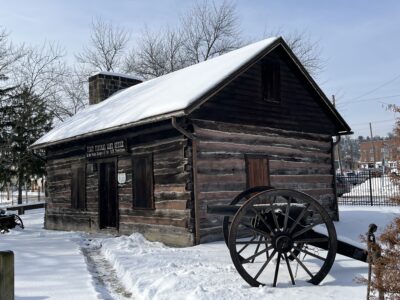
STEUBENVILLE -- The first federal land office, which has been preserved and can be toured at the Historic Fort Steuben complex, has a long history in our area.
The history of the Northwest Territory dates to May 20, 1785, to provide surveying and mapping of the seven ranges of wilderness in the territory northwest of the Ohio River. The Seven Ranges extended 42 miles from the western boundary line of Pennsylvania and north from the Ohio River as far as practicable.
A fort was built in 1786 to protect the surveyors from being attacked by neighboring Indians and wild animals. The fort was named Fort Steuben after Maj. Gen. Baron Friedrich Wilhelm Von Steuben. The fort was protected by two companies of troops from the United States Army. When the survey was completed, the troops moved to Fort Harmar. Fort Steuben was gone by 1790.
Bezaleel Wells and Pittsburgh attorney James Ross founded Steubenville in 1797. They named the town in the memory of the former Fort Steuben.
Registration and sale of public lands in the Steubenville District was established by an act of Congress on May 10, 1800. That act would establish the First Federal Land Office in the United States.
David Hoge of Pennsylvania was appointed registrar of the office by President Thomas Jefferson on May 12, 1800. Zacheus Biggs was the receiver for the Steubenville Land Office and was commissioned on July 1, 1800. By 1801, a lot was bought by Hoge from Wells for $50. Hoge built a house for his family and for the sale of town lots as early as 1809. Steubenville was incorporated in February 1805.
The next receivers were Obediah Jennings and Peter Wilson in 1808. Wilson served until 1821 when his brother-in-law, Gen. Samuel Stokely, was appointed. He served for 12 years and was succeeded by John H. Viers, who served until the Steubenville Land Office District was discontinued by Congress in 1840. At that time, the unsold lands were placed in the Chillicothe district in Ross County.
The land office has been preserved to show its original role as a land office and as Hoge’s family home. Inside the land office is a horsehair trunk that belonged to William Henry Harrison, the ninth president of the United States. There also are land records and deeds, and wool and linen napkins woven from flax grown in Jefferson County. Flax was used as a food and fiber crop and was the source of linseed oil. Wool is another name. The first woolen mills in the United States were made by Steubenville founder Wells.
The land office was moved to the following locations: Lot 113 on Third Street, north of Washington Street, where it remained until 1821. The next move was to the northeast corner of Market Street and Alley Street (now Court Street.) In 1828, it was moved to Lot 61 on the east side of South Third Street between Market and Adams streets. In 1840, the land office was closed. It was encased in a brick veneer almost forgotten for over a century.
In 1940, Henry Roberts, a local barber, contacted George J. Barthold, a prominent citizen, and exclaimed: “They are tearing down our land office.”
The logs were saved, numbered and stored in a barn west of Steubenville. A year later, due to the efforts of the local chapter of the National Society of the United States Daughters of 1812, interested parties and school children, the log cabin was re-erected on U S Route 22, west of Steubenville. The land office stood there for nearly 25 years.
This location was across the street of the former Jefferson County Home for the Aged. During April 1941, posters were made asking children of surrounding schools and citizens of the area to donate to this cause. A bronze sign was added at this time to signify that this building was the First Federal Land Office.
During World War II, a widow’s walk was added to the roof, and the land office became a civilian defense air raid watch station.
The county home was demolished in the 1960s to build the Jefferson County Technical Institute, which today is Youngstown State-Steubenville.
The land office was moved and re-constructed on a site near the former Fort Steuben Bridge and was rededicated on July 4, 1965. This was 165 years after its founding in 1800. The land office was open to tourists and everyone who was interested in the history of the land office. Inside the land office was a hostess on duty at certain times to act as a guide.
One of the hostesses was Barbara Sweeney. During that time, the Land Office Museum was open to the public from Memorial Day through Labor Day from 1 p.m. to 5 p.m. except Mondays. The large bell is from the present Jefferson County Courthouse that was dedicated in 1874. The bell was removed in 1923 for safety reasons. The bell originally rang every 30 minutes. This bell weighs 5,700 pounds and the cost for the bell was $3,081.
A letter dated 1964 was sent to Katherine Sinclair Minor to City Engineer Samuel N. Johnson Jr. regarding the land office. His reply to Minor was: “The land office has been completely disassembled and the logs have been shipped to Orrville, where they will be treated by the Koppers Co. using their wool minimizing pressure treatment” (this treatment was used to clean a structure and minimize any damage to the item.)
A letter from Minor to Steubenville Mayor John W. Targoss stated: “Due to Sunset Boulevard being widened, we plan to renovate it by adding a new roof and weathering (protection from heat, water and wind.)”
In 1965, the land office was placed near the intersection of state Route 7 and U.S. Route 22. A flag was raised at this location by area Girl Scouts and Boy Scouts. The flag that was used for this ceremony contained 15 stars representing the 15 states that were part of the nation from 1795-1818. The flag was donated to George Barthold by Vivian Snyder. Snyder was on a committee seeking authentic items for the land office. She also was a member of the Jefferson County Historical Museum and Library in Steubenville.
Color photos of the land office in 1966 show it with its original logs after the logs had been treated to preserve them. One photo shows the new roof that was added to preserve the land office.
The permanent home for this historic First Federal Land Office and the historic bell is on the property of the Historic Fort Steuben located on 120 S. Third St. in Steubenville. The land office and the bell are located in the same section of the fort. Anyone who wants to see the inside of the land office and wants to ring the historic bell can ask anyone in the Visitor Center of the fort to unlock the gated property that protects the land office and the historic bell. The bell is 153 years old this year, while the land office is 240 years old.
It is important to note that the log building is the original land office and has been preserved for centuries. Only the roof and floor have been updated.
(Day is a retired local historian for the Public Library of Steubenville and Jefferson County. She is a volunteer and life member of the Jefferson County Historical Museum and Library, which is located at 426 Franklin Ave. in Steubenville.)