
Greek Easter bread a tradition of the holiday for Philoptochos Society
Trending
Greek Easter, being marked Sunday, is a holiday that includes a sweet staple -- Tsoureke or Easter bread.
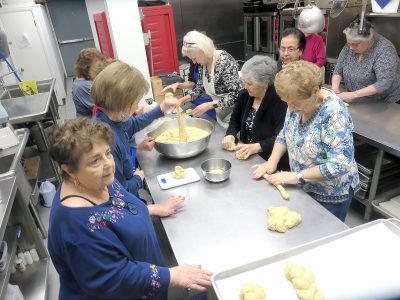
Members of the Philoptochos Society of Holy Trinity Greek Orthodox Church in Steubenville, along with some male helpers from the church, spent some of April 11 and 12 making approximately 400 loaves as part of an annual fundraiser for pre-orders.
Church member John Scavdis, a representative of the male crew that helped with heavy lifting and dough preparation, explained the recipe includes eggs, butter, milk, yeast, sugar, vanilla and cinnamon spice flavoring.
"They've been doing this for as long as I can remember -- many years," Scavdis said of the tradition to make the braided bread.
Though not a difficult process, it is nonetheless a time-consuming one, he explained.
"We have to start early in the morning to make the dough because it goes through three periods of dough rising," he said. "We have to make the dough, and it rises, and then we break it down into three balls which are going to be the three parts of the braid, and then we let that rise, and then after they braid the bread, it has another period of dough rising."
When that's done, the dough is measured out into so many ounces and rolled into ropes with three braids for one loaf that is brushed with an egg wash. Four loaves go on a parchment-lined tray for a final raising. Then the loaves are brushed with an egg wash nad baked for about 40 minute.
The process is one that's enjoyed in an environment of camaraderie and efficiency, as the bread-making is a kind of science, according to Marianne Balako, Philoptochos vice president.
"We use three 8-ounce balls of dough for each loaf of bread so when it's cooked it weighs at least a pound and a half," Balakos said.
The three braids are said to symbolize the Holy Trinity
Everyone looks forward to eating the bread, agreed Balakos, a professed nonbaker. "No one looks forward to making it," she quipped.