
Lawmakers clash with DoHS secretary over delayed school clothing allowance
Trending
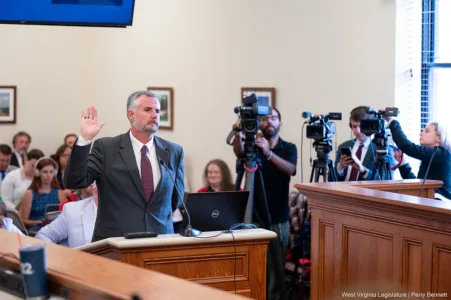
CHARLESTON – Carl Ayers, the new cabinet secretary of the West Virginia Department of Human Resources, answered questions from lawmakers about delays in the school clothing voucher program, but left lawmakers with more questions.
Ayers was on hand Tuesday afternoon for nearly 90 minutes answering questions about the School Clothing Allowance program and Temporary Assistance for Needy Families (TANF) for members of the Legislative Oversight Commission on Health and Human Resources Accountability, the last meeting of August’s three-day interim meetings at the State Capitol Building.
Gov. Patrick Morrisey has said since May that a structural deficit exists within the TANF program, also called WV WORKS, in the current fiscal year due to expenses outpacing the federal TANF block grant.
The Governor's Office estimates there is a $38 million gap between $98.8 million in available federal TANF dollars and approximately $137 million in TANF-funded expenses, with less than 13 months left in TANF carryover funds from previous fiscal years, sitting at approximately $41 million.
Morrisey has said the state used federal COVID-19 funds to increase spending on TANF programs. When those one-time monies went away, TANF spending did not decrease, causing the state to use TANF carryover funds to bridge past structural deficits.
Lawmakers have expressed frustration with the Morrisey administration for its handling of the TANF structural deficit, which saw several programs paused at the beginning of the new fiscal year in July and an abbreviated School Clothing Allowance program due to alleged funding issues.
The School Clothing Allowance program provides $200 to each eligible child in a family to purchase clothing and back-to-school supplies. Families must fall under 30% of the federal poverty level to qualify. The program serves children aged 4 through 18.
Since 2022, School Clothing Allowance benefits have been loaded onto EBT cards, which function like debit cards. Foster children are an exception, receiving their benefits via checks sent to foster parents.
Last year, the School Clothing Allowance program served approximately 57,000 children and cost $11.4 million, with families applying between July 7, 2025, and July 31, 2025. This year, the program’s application window did not open until July 20 and closed on July 27 after DoHS projected the program exhaust the same amount of funding allotted last year.
As of Aug. 3, 52,000 applications had been received according to the Governor’s Office, but it was unclear if all applications would be approved. During his testimony Tuesday, Ayers would not provide a specific number of applicants for this year’s program.
“The reason the program was delayed in opening was due to the TANF structural imbalance,” Ayers said. “So, the governor ordered a look at that and delayed the opening of the program while he was looking at TANF.”
Last week, Morrisey and the Governor’s Office released data showing that approximately 50% of School Clothing Allowance benefits are pulled off of the EBT cards through ATM machines, making the purchases made with of School Clothing Allowance funds untraceable, with the governor stating, “I want the money for school clothes, not for beer or cigarettes.”
“Whenever the benefit is placed on an EBT card, the EBT benefit can be used at ATMs to pull any amount of that benefit, including up to the full amount, off of the card,” Ayers said. “So, as you look at how those benefits are spent, once they are pulled into cash, I have no way to account for how the benefit was spent.”
“I guess I’m not so focused on the cash issue,” said commission co-chair Evan Worrell, R-Cabell. “I have eight children. Every time I turn around, my wife’s selling clothes on Facebook Marketplace. And I would assume that people get the best bang for the buck. When $200 doesn’t go very far, they’re going to try to find good options to buy cheap clothes. And so, they need to take that cash assistance off. That’s my assumption.”
According to data pulled by DoHS from the state’s EBT card partner, Fidelity Information Services, of the remaining 50% of School Clothing Allowance benefits not taken out by ATM, 37% of point of sale (POS) purchases were made at multi-purpose retailers (Walmart, Target, etc.), 35.5% came from cash withdrawals via banks, 10.5% were used convenience stores, 10% were used at clothing retailers, 5.5% were used at grocery stores, less than 2% were used at hotels or other miscellaneous retailers, and less than 1% were used at alcohol, tobacco, cannabis and gaming locations.
“I want to be very clear: I support providing school clothing allotments to the neediest West Virginians,” Morrisey said in a post on social media Tuesday night. “However, if we are going to have such a benefit, we should be able to show that the actual monies spent are for SCHOOL CLOTHING!! The current school clothing benefit does not do that – and that's the problem that we need to fix.”
Ayers said that While POS devices are technically blocked from operating at adult entertainment or liquor stores, ATM withdrawals allow for cash access at such locations. But under questioning by commission members, it was not clear whether this was reflective if misuse by participants of the School Clothing Allowance program or use by WV WORKS recipients receiving both their monthly TANF benefit and the School Clothing Allowance benefit on the same EBT card.
“I agree that any time there’s a cash benefit that’s going to go out, or any benefit of any kind from the state to any group of people, there’s going to be people who try to cheat it,” said state Sen. Eric Tarr, R-Putnam. “What I take offense with is that to say because ... you have a card that can be used for everything else, you’re saying that’s given as evidence that, hey, we’re seeing signs of abuse here.”
“I guess at first blush, that doesn’t seem like the most reliable way to track how the vouchers are actually being used,” said Del. Geno Chiarelli, R-Monongalia. “It seems like there’s data being collected and it’s being analyzed, and it’s being relayed to us as this is how we’re tracking the voucher. I don’t know how we could take that as accurate. I don’t know how we could determine that that’s reliable.”
“There’s no way to determine which funds was being used, pulled off this card, if there was money already on the card,” Del. Anitra Hamilton, D-Monongalia. “There’s no way to determine that it was specifically the clothing voucher. That’s an assumption being made.”
Lawmakers asked Ayers for where the complaints about alleged fraud in the School Clothing Allowance program came. Ayers would not provide specific beyond saying the complaints were passed down from the Governor’s Office.
“Ultimately, this all started with some sort of complaint that there was fraud going along with the school vouchers,” said state Sen. Vince Deeds, R-Greenbrier. “I do not understand about who filed the complaint, why there’s been a delay, and why it is still so unsettled, especially since all this money comes out of the same account, ultimately, at the end of the day. There’s no way to prove that anybody is doing anything nefarious with school vouchers, because it all comes off the same EBT card.”
Commission Co-Chairman Brian Helton, R-Fayette, has been charged by Morrisey with investigating the School Clothing Allowance program as chairman of the Senate Health and Human Resources Committee.
“We can’t have situations where we have kids at risk who need these clothes, and that money’s intended for them, yet we’re going to let that be cashed out at the Venus Lounge, at CJ’s Liquor Store, at Wanda’s Bar, at a hotel somewhere, And this kid needs those clothes,” Helton said. “I’m not being accusatory, but I’ve seen it in real life, so let’s just be practical about it.”
“Some of the statements that have been made around this sound terribly elitist to me,” Tarr said, responding to Helton’s closing comments. “I had friends that live over bars. I’ve had friends that have lived over strip clubs … I have walked myself down the street when I was probably eight years old to the bar to ask for bread ... I hope that when you’re making these comments, Mr. Chairman, that you take that into account.”